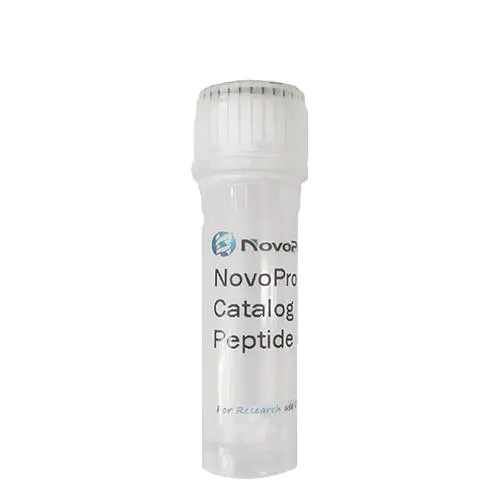
Vasoactive intestinal polypeptide, VIP
Not For Human Use, Lab Use Only.
Cat.#: 312079
Special Price 328.60 USD
Availability:
5 working days
-
Product Name
Vasoactive intestinal polypeptide, VIP
-
Documents
Batch to batch variation of the purity
-
Sequence Shortening
HSDAVFTDNYTRLRKQMAVKKYLNSILN-NH2
-
Sequence
His-Ser-Asp-Ala-Val-Phe-Thr-Asp-Asn-Tyr-Thr-Arg-Leu-Arg-Lys-Gln-Met-Ala-Val-Lys-Lys-Tyr-Leu-Asn-Ser-Ile-Leu-Asn-NH2
-
Length (aa)
28
-
Peptide Purity (HPLC)
98.03%
-
Molecular Formula
C147H238N44O42S
-
Molecular Weight
3325.8
-
CAS No.
40077-57-4
-
Source
Synthetic
-
Form
Powder
-
Description
Vasoactive intestinal polypeptide (VIP) is a peptide consisting of 28 amino acid residues and belongs to the glucagon/secretin superfamily. VIP was first isolated as a potent vasodilator from the porcine duodenum in 1970. It is widespread in many internal organs and systems, functioning as a neurotransmitter and/or neuromodulator in both the central and peripheral nervous systems. VIP exerts its effects through two types of G protein-coupled receptors, VPAC1 and VPAC2, which stimulate cellular adenylyl cyclase activity and the protein kinase A pathway, and may also regulate other cellular pathways involving nitric oxide, phospholipase C, and MAP kinases.
In the carotid body, VIP-positive nerve fibers have been identified in numerous species including mammals, birds, and amphibians. These nerve fibers are characterized by numerous varicosities and are primarily located in connective tissue between glomus cell clusters and near blood vessels. The distribution of VIP in the carotid body shows clear interspecies differences, with VIP found in nerve fibers in most species, though in humans it has also been described in glomus cells. The number of VIP-containing nerves in the carotid body can change under various physiological and pathological factors, including hypoxia. VIP is known to impact glomus type I cells, causing changes in their spontaneous discharge, but its main impact on the carotid body is likely connected with vasodilatory effects and influence on blood flow and oxygen delivery.
-
Storage Guidelines
Normally, this peptide will be delivered in lyophilized form and should be stored in a freezer at or below -20 °C. For more details, please refer to the manual: Handling and Storage of Synthetic Peptides
-
References
- Gonkowski S. Vasoactive Intestinal Polypeptide in the Carotid Body-A History of Forty Years of Research. A Mini Review. Int J Mol Sci. 2020 Jun 30;21(13):4692. doi: 10.3390/ijms21134692. PMID: 32630153; PMCID: PMC7370131.
- Mutt V, Said SI. Structure of the porcine vasoactive intestinal octacosapeptide. The amino-acid sequence. Use of kallikrein in its determination. Eur J Biochem. 1974;42(2):581-9.
- O'Donnell M, Garippa RJ, O'Neill NC, Bolin DR, Cottrell JM. Structure-activity studies of vasoactive intestinal polypeptide. J Biol Chem. 1991 Apr 5;266(10):6389-92. PMID: 1848854.
-
About TFA salt
Trifluoroacetic acid (TFA) is a common counterion from the purification process using High-Performance Liquid Chromatography (HPLC). The presence of TFA can affect the peptide's net weight, appearance, and solubility.
Impact on Net Weight: The TFA salt contributes to the total mass of the product. In most cases, the peptide content constitutes >80% of the total weight, with TFA accounting for the remainder.
Solubility: TFA salts generally enhance the solubility of peptides in aqueous solutions.
In Biological Assays: For most standard in vitro assays, the residual TFA levels do not cause interference. However, for highly sensitive cellular or biochemical studies, please be aware of its presence.
-
Molar Concentration Calculator
-
Dilution Calculator
-
Percent Concentration Calculator
Mass (g) = Concentration (mol/L) × Volume (L) × Molecular Weight (g/mol)
Related Products / Services
• Peptide Services: NovoPro's peptide synthesis services include standard chemical peptide synthesis, peptide modification, peptide libraries, and recombinant peptide expression.
• Standard Peptide Synthesis: NovoPro offers quality peptides at the most competitive prices in the industry, starting at $3.20 per amino acid. NovoPro provides PepBox – Automatic Quote Tool for online price calculation.
• Peptide Modifications: NovoPro offers a wide range of peptide modification services including isotope labeling (2H, 15N, and 13C), multiple disulfide bonds, multiple phosphorylations, KLH, BSA, ovalbumin, amidation, acetylation, biotin, FITC, etc.
Please note: All products are "FOR RESEARCH USE ONLY AND ARE NOT INTENDED FOR DIAGNOSTIC OR THERAPEUTIC USE"