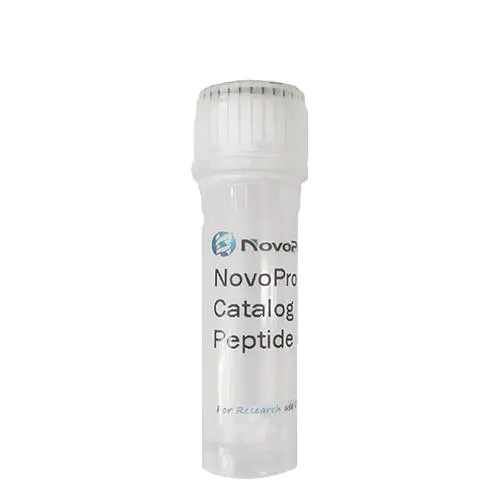
RP557 peptide
Not For Human Use, Lab Use Only.
Cat.#: 318950
Special Price 526.80 USD
Availability:
5 working days
-
Product Name
RP557 peptide
-
Documents
Batch to batch variation of the purity
-
Sequence Shortening
H-RFCWKVCYKGICFKKCK-NH2 (C3-C16 and C7-C12 disulfide bonds)
-
Sequence
H-Arg-Phe-Cys-Trp-Lys-Val-Cys-Tyr-Lys-Gly-Ile-Cys-Phe-Lys-Lys-Cys-Lys-Amidation (C3-C16 and C7-C12 disulfide bonds)
-
Length (aa)
17
-
Peptide Purity (HPLC)
95.2%
-
Molecular Formula
C99H155N27O18S4
-
Molecular Weight
2135.7
-
Source
Synthetic
-
Form
Powder
-
Description
RP557 is a designed antimicrobial peptide (dAMP) derived from tachyplesin I, a disulfide β-sheet antimicrobial peptide found in the horseshoe crab Tachypleus tridentatus. It consists of 17 amino acids with the sequence RFCWKVCYKGICFKKCK and features disulfide bridges between C3–C16 and C7–C12. RP557 exhibits broad-spectrum antifungal activity against various Candida species, including fluconazole-resistant strains such as C. albicans, C. glabrata, and C. tropicalis, with MIC values ranging from 1.9 to 15 μM (4 to 32 μg/ml). The peptide demonstrates potent fungicidal activity, as evidenced by minimal differences between its MIC and MFC values.
RP557 is particularly effective against Candida biofilms, inhibiting both biofilm formation and disrupting preformed biofilms at concentrations lower than those required for planktonic cells. Scanning electron microscopy reveals that RP557 induces significant membrane perturbation in fungal cells, leading to cell wall damage. Additionally, RP557 shows limited cytotoxicity to mammalian cells, with an LD10 of 287 μg/ml (134 μM) in human keratinocytes, indicating selective antifungal action. Its mechanism involves direct membranolytic activity, likely due to electrostatic interactions with fungal membranes, and it exhibits a low propensity for inducing resistance in Candida species.
-
Storage Guidelines
Normally, this peptide will be delivered in lyophilized form and should be stored in a freezer at or below -20 °C. For more details, please refer to the manual: Handling and Storage of Synthetic Peptides
-
References
- Woodburn KW, Clemens LE, Jaynes J, et al. Designed Antimicrobial Peptides for Recurrent Vulvovaginal Candidiasis Treatment. Antimicrob Agents Chemother. 2019;63(11):e02690-18. Published 2019 Oct 22. doi:10.1128/AAC.02690-18
-
About TFA salt
Trifluoroacetic acid (TFA) is a common counterion from the purification process using High-Performance Liquid Chromatography (HPLC). The presence of TFA can affect the peptide's net weight, appearance, and solubility.
Impact on Net Weight: The TFA salt contributes to the total mass of the product. In most cases, the peptide content constitutes >80% of the total weight, with TFA accounting for the remainder.
Solubility: TFA salts generally enhance the solubility of peptides in aqueous solutions.
In Biological Assays: For most standard in vitro assays, the residual TFA levels do not cause interference. However, for highly sensitive cellular or biochemical studies, please be aware of its presence.
-
Molar Concentration Calculator
-
Dilution Calculator
-
Percent Concentration Calculator
Mass (g) = Concentration (mol/L) × Volume (L) × Molecular Weight (g/mol)
Related Products / Services
• Peptide Services: NovoPro's peptide synthesis services include standard chemical peptide synthesis, peptide modification, peptide libraries, and recombinant peptide expression.
• Standard Peptide Synthesis: NovoPro offers quality peptides at the most competitive prices in the industry, starting at $3.20 per amino acid. NovoPro provides PepBox – Automatic Quote Tool for online price calculation.
• Peptide Modifications: NovoPro offers a wide range of peptide modification services including isotope labeling (2H, 15N, and 13C), multiple disulfide bonds, multiple phosphorylations, KLH, BSA, ovalbumin, amidation, acetylation, biotin, FITC, etc.
Please note: All products are "FOR RESEARCH USE ONLY AND ARE NOT INTENDED FOR DIAGNOSTIC OR THERAPEUTIC USE"