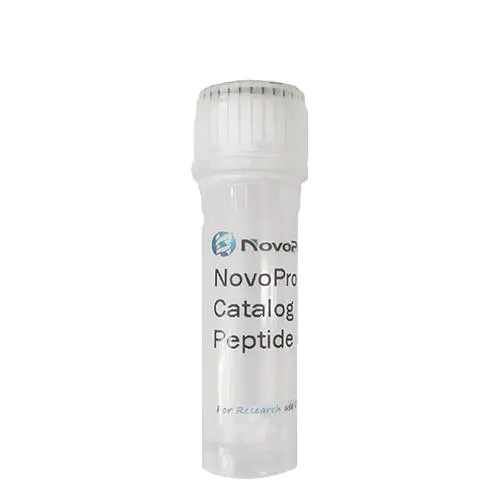
STAMP C16G2 peptide
Not For Human Use, Lab Use Only.
Cat.#: 319389
Special Price 502.80 USD
Availability:
5 working days
-
Product Name
STAMP C16G2 peptide
-
Documents
Batch to batch variation of the purity
-
Sequence Shortening
H-TFFRLFNRSFTQALGKGGGKNLRIIRKGIHIIKKY-NH2
-
Sequence
H-Thr-Phe-Phe-Arg-Leu-Phe-Asn-Arg-Ser-Phe-Thr-Gln-Ala-Leu-Gly-Lys-Gly-Gly-Gly-Lys-Asn-Leu-Arg-Ile-Ile-Arg-Lys-Gly-Ile-His-Ile-Ile-Lys-Lys-Tyr-NH2
-
Length (aa)
35
-
Peptide Purity (HPLC)
95.34%
-
Molecular Formula
C190H309N57O43
-
Molecular Weight
4078.86
-
CAS No.
2154327-48-5
-
Source
Synthetic
-
Form
Powder
-
Description
C16G2 is a specifically targeted antimicrobial peptide (STAMP) designed to selectively target the cariogenic oral pathogen Streptococcus mutans. It is a chimeric molecule consisting of two functional domains: a targeting domain derived from a truncated version of the S. mutans competence-stimulating peptide (CSP), designated CSPC16, and a killing domain, G2, a truncated variant of the broad-spectrum antimicrobial peptide novispirin G10. These domains are connected by a flexible tri-glycine linker. The peptide exhibits a predicted amphipathic alpha-helical structure.
The primary mode of action for C16G2 is the selective disruption of the bacterial cell membrane. Studies demonstrate that C16G2 rapidly and potently increases membrane permeability in S. mutans, leading to the efflux of intracellular small molecules such as ATP and the uptake of membrane-impermeant dyes. This activity is followed by a loss of membrane potential, culminating in cell death. In contrast to broad-spectrum antimicrobial peptides like melittin B, C16G2 displays significant specificity, showing robust membrane-disrupting activity against S. mutans while having minimal effects on other non-cariogenic oral streptococci. This selectivity is dependent on the conjugated targeting domain, as the isolated killing moiety (G2) exhibits only modest, non-specific antimicrobial activity.
-
Storage Guidelines
Normally, this peptide will be delivered in lyophilized form and should be stored in a freezer at or below -20 °C. For more details, please refer to the manual: Handling and Storage of Synthetic Peptides
-
References
- Batoni G, Maisetta G, Esin S. Therapeutic Potential of Antimicrobial Peptides in Polymicrobial Biofilm-Associated Infections. Int J Mol Sci. 2021 Jan 6;22(2):482. doi: 10.3390/ijms22020482. PMID: 33418930; PMCID: PMC7825036.
-
About TFA salt
Trifluoroacetic acid (TFA) is a common counterion from the purification process using High-Performance Liquid Chromatography (HPLC). The presence of TFA can affect the peptide's net weight, appearance, and solubility.
Impact on Net Weight: The TFA salt contributes to the total mass of the product. In most cases, the peptide content constitutes >80% of the total weight, with TFA accounting for the remainder.
Solubility: TFA salts generally enhance the solubility of peptides in aqueous solutions.
In Biological Assays: For most standard in vitro assays, the residual TFA levels do not cause interference. However, for highly sensitive cellular or biochemical studies, please be aware of its presence.
-
Molar Concentration Calculator
-
Dilution Calculator
-
Percent Concentration Calculator
Mass (g) = Concentration (mol/L) × Volume (L) × Molecular Weight (g/mol)
Related Products / Services
• Peptide Services: NovoPro's peptide synthesis services include standard chemical peptide synthesis, peptide modification, peptide libraries, and recombinant peptide expression.
• Standard Peptide Synthesis: NovoPro offers quality peptides at the most competitive prices in the industry, starting at $3.20 per amino acid. NovoPro provides PepBox – Automatic Quote Tool for online price calculation.
• Peptide Modifications: NovoPro offers a wide range of peptide modification services including isotope labeling (2H, 15N, and 13C), multiple disulfide bonds, multiple phosphorylations, KLH, BSA, ovalbumin, amidation, acetylation, biotin, FITC, etc.
Please note: All products are "FOR RESEARCH USE ONLY AND ARE NOT INTENDED FOR DIAGNOSTIC OR THERAPEUTIC USE"