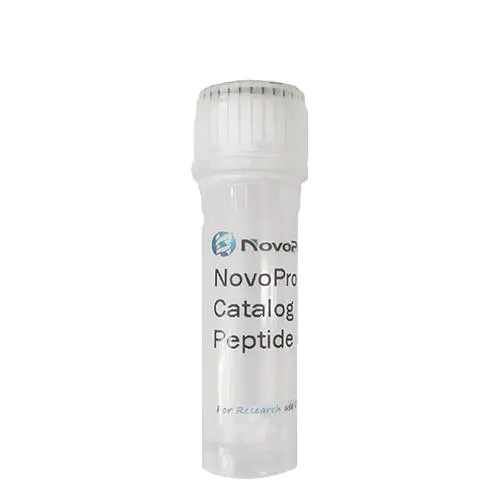
Septide peptide
Not For Human Use, Lab Use Only.
Cat.#: 319679
Special Price 162.70 USD
Availability:
1-2 weeks
-
Product Name
Septide peptide
-
Documents
Batch to batch variation of the purity
-
Sequence Shortening
Pyr-FFPLM-NH2
-
Sequence
Pyr-Phe-Phe-Pro-Leu-Met-NH2
-
Length (aa)
5
-
Peptide Purity (HPLC)
95.82%
-
Molecular Formula
C39H53N7O7S
-
Molecular Weight
763.94
-
CAS No.
79775-19-2
-
PubChem CID
119137
-
Source
Synthetic
-
Form
Powder
-
Description
Septide is a synthetic peptide with the amino acid sequence [pGlu6, Pro9]Substance P9-11. It is known to have tachykinin-like actions despite its apparent lack of binding to any known tachykinin receptor initially. However, later studies have shown that Septide binds to the NK-1 receptor with high affinity.
Binding Affinity to NK-1 Receptor: In homologous binding assays, Septide has a Kd value of 0.55 ± 0.03 nM, indicating high-affinity binding to the NK-1 receptor. In competition against radiolabeled NKA, Septide also appears as a high-affinity ligand on the NK-1 receptor, with a Ki value of 1.90 ± 0.35 nM. Similarly, NKA can compete with high affinity for Septide binding on the NK-1 receptor, with a Ki value of 0.21 ± 0.01 nM.
Role in Tachykinin Receptor Actions: The finding that Septide binds with high affinity to the NK-1 receptor suggests that the NK-1 receptor may function as a general tachykinin receptor, binding subnanomolar concentrations of not only the naturally occurring neuropeptides substance P (SP) and neurokinin A (NKA), but also the synthetic peptide Septide. This observation challenges the previous notion that a special "septide receptor" or an extra NKA binding receptor might exist.
Overall, Septide is an important peptide in the study of tachykinin receptors and their functions, providing insights into the complex interactions between peptides and receptors in the nervous system. -
Storage Guidelines
Normally, this peptide will be delivered in lyophilized form and should be stored in a freezer at or below -20 °C. For more details, please refer to the manual: Handling and Storage of Synthetic Peptides
-
References
- Hastrup H, Schwartz TW. Septide and neurokinin A are high-affinity ligands on the NK-1 receptor: evidence from homologous versus heterologous binding analysis. FEBS Lett. 1996 Dec 16;399(3):264-6. doi: 10.1016/s0014-5793(96)01337-3. PMID: 8985159.
-
About TFA salt
Trifluoroacetic acid (TFA) is a common counterion from the purification process using High-Performance Liquid Chromatography (HPLC). The presence of TFA can affect the peptide's net weight, appearance, and solubility.
Impact on Net Weight: The TFA salt contributes to the total mass of the product. In most cases, the peptide content constitutes >80% of the total weight, with TFA accounting for the remainder.
Solubility: TFA salts generally enhance the solubility of peptides in aqueous solutions.
In Biological Assays: For most standard in vitro assays, the residual TFA levels do not cause interference. However, for highly sensitive cellular or biochemical studies, please be aware of its presence.
-
Molar Concentration Calculator
-
Dilution Calculator
-
Percent Concentration Calculator
Mass (g) = Concentration (mol/L) × Volume (L) × Molecular Weight (g/mol)
Related Products / Services
• Peptide Services: NovoPro's peptide synthesis services include standard chemical peptide synthesis, peptide modification, peptide libraries, and recombinant peptide expression.
• Standard Peptide Synthesis: NovoPro offers quality peptides at the most competitive prices in the industry, starting at $3.20 per amino acid. NovoPro provides PepBox – Automatic Quote Tool for online price calculation.
• Peptide Modifications: NovoPro offers a wide range of peptide modification services including isotope labeling (2H, 15N, and 13C), multiple disulfide bonds, multiple phosphorylations, KLH, BSA, ovalbumin, amidation, acetylation, biotin, FITC, etc.
Please note: All products are "FOR RESEARCH USE ONLY AND ARE NOT INTENDED FOR DIAGNOSTIC OR THERAPEUTIC USE"