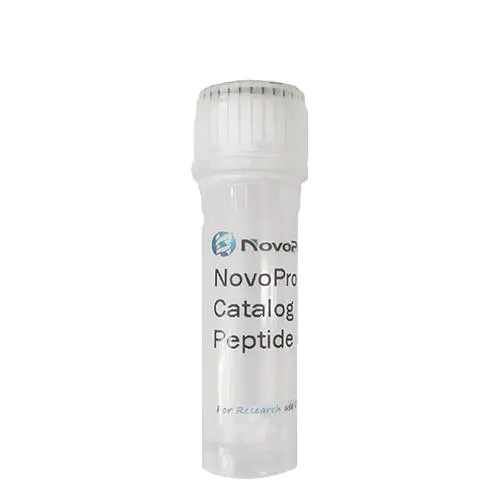
Rugosin B peptide
Not For Human Use, Lab Use Only.
Cat.#: 300042
Special Price 527.40 USD
Availability:
5 working days
-
Product Name
Rugosin B peptide
-
Documents
Batch to batch variation of the purity
-
Sequence Shortening
SLFSLIKAGAKFLGKNLLKQGAQYAACKVSKEC (disulfide bond: Cys27-Cys33)
-
Sequence
H-Ser-Leu-Phe-Ser-Leu-Ile-Lys-Ala-Gly-Ala-Lys-Phe-Leu-Gly-Lys-Asn-Leu-Leu-Lys-Gln-Gly-Ala-Gln-Tyr-Ala-Ala-Cys-Lys-Val-Ser-Lys-Glu-Cys-OH (disulfide bond: Cys27-Cys33)
-
Length (aa)
33
-
Peptide Purity (HPLC)
95.15%
-
Molecular Formula
C159H262N42O43S2
-
Molecular Weight
3514.16
-
Source
Synthetic
-
Form
Powder
-
Description
Rugosin B is a cyclic peptide isolated from the plant Rubia yunnanensis. It is characterized by a unique structure consisting of seven amino acid residues, including tyrosine, proline, and phenylalanine, forming a macrocyclic ring. The peptide exhibits a stable conformation due to intramolecular hydrogen bonds and hydrophobic interactions, which contribute to its structural rigidity.
Studies have shown that Rugosin B possesses notable bioactivity, primarily attributed to its cyclic nature and specific amino acid composition. The peptide's compact structure enhances its resistance to enzymatic degradation, making it a subject of interest in biochemical research. Spectroscopic analyses, such as NMR and mass spectrometry, have been employed to elucidate its detailed molecular configuration and stability.
-
Storage Guidelines
Normally, this peptide will be delivered in lyophilized form and should be stored in a freezer at or below -20 °C. For more details, please refer to the manual: Handling and Storage of Synthetic Peptides
-
References
- Suzuki S, Ohe Y, Okubo T, Kakegawa T, Tatemoto K. Isolation and characterization of novel antimicrobial peptides, rugosins A, B and C, from the skin of the frog, Rana rugosa. Biochem Biophys Res Commun. 1995;212(1):249-54.
-
About TFA salt
Trifluoroacetic acid (TFA) is a common counterion from the purification process using High-Performance Liquid Chromatography (HPLC). The presence of TFA can affect the peptide's net weight, appearance, and solubility.
Impact on Net Weight: The TFA salt contributes to the total mass of the product. In most cases, the peptide content constitutes >80% of the total weight, with TFA accounting for the remainder.
Solubility: TFA salts generally enhance the solubility of peptides in aqueous solutions.
In Biological Assays: For most standard in vitro assays, the residual TFA levels do not cause interference. However, for highly sensitive cellular or biochemical studies, please be aware of its presence.
-
Molar Concentration Calculator
-
Dilution Calculator
-
Percent Concentration Calculator
Mass (g) = Concentration (mol/L) × Volume (L) × Molecular Weight (g/mol)
Related Products / Services
• Peptide Services: NovoPro's peptide synthesis services include standard chemical peptide synthesis, peptide modification, peptide libraries, and recombinant peptide expression.
• Standard Peptide Synthesis: NovoPro offers quality peptides at the most competitive prices in the industry, starting at $3.20 per amino acid. NovoPro provides PepBox – Automatic Quote Tool for online price calculation.
• Peptide Modifications: NovoPro offers a wide range of peptide modification services including isotope labeling (2H, 15N, and 13C), multiple disulfide bonds, multiple phosphorylations, KLH, BSA, ovalbumin, amidation, acetylation, biotin, FITC, etc.
Please note: All products are "FOR RESEARCH USE ONLY AND ARE NOT INTENDED FOR DIAGNOSTIC OR THERAPEUTIC USE"