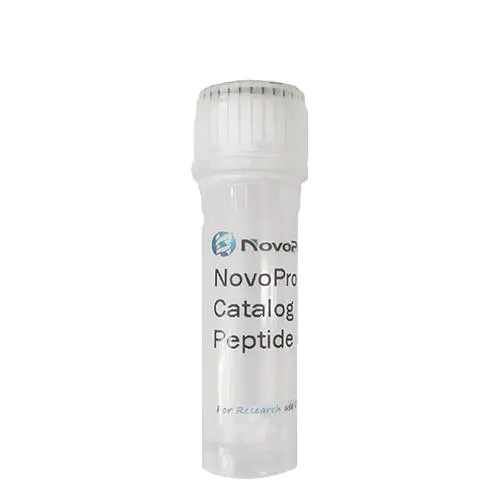
Phoenixin-14 amide (Human) peptide
Not For Human Use, Lab Use Only.
Cat.#: 318955
Special Price 192.40 USD
Availability:
5 working days
-
Product Name
Phoenixin-14 amide (Human) peptide
-
Documents
Batch to batch variation of the purity
-
Sequence Shortening
H-DVQPPGLKVWSDPF-NH2
-
Sequence
H-Asp-Val-Gln-Pro-Pro-Gly-Leu-Lys-Val-Trp-Ser-Asp-Pro-Phe-NH2
-
Length (aa)
14
-
Peptide Purity (HPLC)
98.74%
-
Molecular Formula
C75H110N18O20
-
Molecular Weight
1583.78
-
Source
Synthetic
-
Form
Powder
-
Description
Phoenixin-14 amide (Human) is a recently identified neuropeptide that is part of the gut-brain axis. It is a highly conserved peptide found in multiple species, including humans and rodents. This peptide is recognized for its pleiotropic physiological roles, which extend beyond its initial identification as a reproductive peptide. Scientific investigations have characterized it as a bioactive molecule with modulatory functions in various biological systems.
Experimental studies indicate that Phoenixin-14 exhibits anti-inflammatory and antioxidant properties. Research in model systems demonstrates its capacity to reduce levels of pro-inflammatory cytokines, such as IL-1β, TNF-α, IL-6, and IL-12. Furthermore, it has been shown to decrease oxidative stress markers like malondialdehyde (MDA) and myeloperoxidase (MPO) activity, while enhancing the activity of antioxidant enzymes including superoxide dismutase (SOD) and catalase. These biochemical activities highlight its role in cellular and tissue protective mechanisms within biological contexts.
-
Storage Guidelines
Normally, this peptide will be delivered in lyophilized form and should be stored in a freezer at or below -20 °C. For more details, please refer to the manual: Handling and Storage of Synthetic Peptides
-
References
- Zandeh-Rahimi Y, Panahi N, Hesaraki S, Shirazi-Beheshtiha SH. Protective Effects of Phoenixin-14 Peptide in the Indomethacin-Induced Duodenal Ulcer: An Experimental Study. Int J Pept Res Ther. 2022;28(1):43. doi: 10.1007/s10989-021-10314-9. Epub 2022 Jan 3. PMID: 35002587; PMCID: PMC8722415.
-
About TFA salt
Trifluoroacetic acid (TFA) is a common counterion from the purification process using High-Performance Liquid Chromatography (HPLC). The presence of TFA can affect the peptide's net weight, appearance, and solubility.
Impact on Net Weight: The TFA salt contributes to the total mass of the product. In most cases, the peptide content constitutes >80% of the total weight, with TFA accounting for the remainder.
Solubility: TFA salts generally enhance the solubility of peptides in aqueous solutions.
In Biological Assays: For most standard in vitro assays, the residual TFA levels do not cause interference. However, for highly sensitive cellular or biochemical studies, please be aware of its presence.
-
Molar Concentration Calculator
-
Dilution Calculator
-
Percent Concentration Calculator
Mass (g) = Concentration (mol/L) × Volume (L) × Molecular Weight (g/mol)
Related Products / Services
• Peptide Services: NovoPro's peptide synthesis services include standard chemical peptide synthesis, peptide modification, peptide libraries, and recombinant peptide expression.
• Standard Peptide Synthesis: NovoPro offers quality peptides at the most competitive prices in the industry, starting at $3.20 per amino acid. NovoPro provides PepBox – Automatic Quote Tool for online price calculation.
• Peptide Modifications: NovoPro offers a wide range of peptide modification services including isotope labeling (2H, 15N, and 13C), multiple disulfide bonds, multiple phosphorylations, KLH, BSA, ovalbumin, amidation, acetylation, biotin, FITC, etc.
Please note: All products are "FOR RESEARCH USE ONLY AND ARE NOT INTENDED FOR DIAGNOSTIC OR THERAPEUTIC USE"