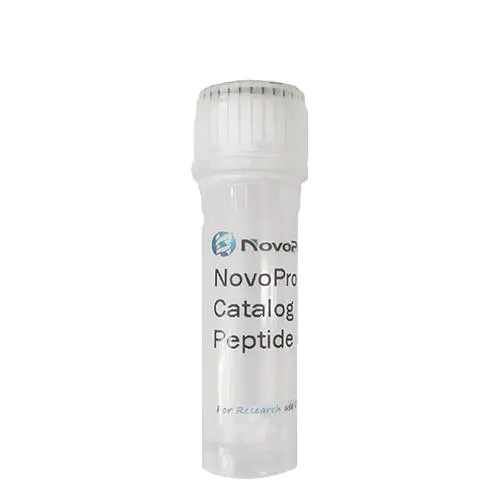
Octalysine (K8) peptide
Not For Human Use, Lab Use Only.
Cat.#: 319840
Special Price 195.20 USD
Availability:
1-2 weeks
-
Product Name
Octalysine (K8) peptide
-
Documents
Batch to batch variation of the purity
-
Sequence Shortening
H-KKKKKKKK-OH
-
Sequence
H-Lys-Lys-Lys-Lys-Lys-Lys-Lys-Lys-OH
-
Length (aa)
8
-
Peptide Purity (HPLC)
98.01%
-
Molecular Formula
C48H98N16O9
-
Molecular Weight
1043.39
-
PubChem CID
505309139
-
Source
Synthetic
-
Form
Powder
-
Description
The K8 peptide, an octalysine-modified cell-penetrating peptide, is a cationic peptide composed of eight lysine residues. It is structurally analogous to the octaarginine (R8) peptide but differs in its amino acid composition, replacing arginine with lysine. Studies comparing K8-modified liposomes (K8-Lip) with R8-modified liposomes (R8-Lip) have shown that K8-Lip exhibits similar physical properties, such as size and ζ-potential, but demonstrates significantly lower efficiency in promoting cross-presentation of antigen peptides. Unlike R8-Lip, K8-Lip does not enhance the C-terminal trimming of antigen-derived peptides, a critical step in generating mature MHC-I peptides. This functional disparity highlights the unique role of arginine-rich peptides in antigen processing.
Further investigations reveal that K8-Lip and R8-Lip share comparable cellular uptake mechanisms, primarily through macropinocytosis, and exhibit similar endosomal escape efficiencies in dendritic cells. However, K8-Lip fails to enhance proteasome-dependent C-terminal trimming of extended antigen peptides, such as SIINFEKLTEWTS, which is essential for efficient MHC-I presentation. These findings suggest that the lysine-rich structure of K8, unlike the arginine-rich R8, lacks the capacity to modulate proteasomal activity or downstream peptide processing, underscoring the specificity of arginine residues in optimizing antigen presentation pathways.
-
Storage Guidelines
Normally, this peptide will be delivered in lyophilized form and should be stored in a freezer at or below -20 °C. For more details, please refer to the manual: Handling and Storage of Synthetic Peptides
-
References
- Nakamura, T., Ono, K., Suzuki, Y., Moriguchi, R., Kogure, K., & Harashima, H. (2014). Octaarginine-modified liposomes enhance cross-presentation by promoting the C-terminal trimming of antigen peptide. Molecular pharmaceutics, 11(8), 2787–2795. https://doi.org/10.1021/mp500147y
-
About TFA salt
Trifluoroacetic acid (TFA) is a common counterion from the purification process using High-Performance Liquid Chromatography (HPLC). The presence of TFA can affect the peptide's net weight, appearance, and solubility.
Impact on Net Weight: The TFA salt contributes to the total mass of the product. In most cases, the peptide content constitutes >80% of the total weight, with TFA accounting for the remainder.
Solubility: TFA salts generally enhance the solubility of peptides in aqueous solutions.
In Biological Assays: For most standard in vitro assays, the residual TFA levels do not cause interference. However, for highly sensitive cellular or biochemical studies, please be aware of its presence.
-
Molar Concentration Calculator
-
Dilution Calculator
-
Percent Concentration Calculator
Mass (g) = Concentration (mol/L) × Volume (L) × Molecular Weight (g/mol)
Related Products / Services
• Peptide Services: NovoPro's peptide synthesis services include standard chemical peptide synthesis, peptide modification, peptide libraries, and recombinant peptide expression.
• Standard Peptide Synthesis: NovoPro offers quality peptides at the most competitive prices in the industry, starting at $3.20 per amino acid. NovoPro provides PepBox – Automatic Quote Tool for online price calculation.
• Peptide Modifications: NovoPro offers a wide range of peptide modification services including isotope labeling (2H, 15N, and 13C), multiple disulfide bonds, multiple phosphorylations, KLH, BSA, ovalbumin, amidation, acetylation, biotin, FITC, etc.
Please note: All products are "FOR RESEARCH USE ONLY AND ARE NOT INTENDED FOR DIAGNOSTIC OR THERAPEUTIC USE"