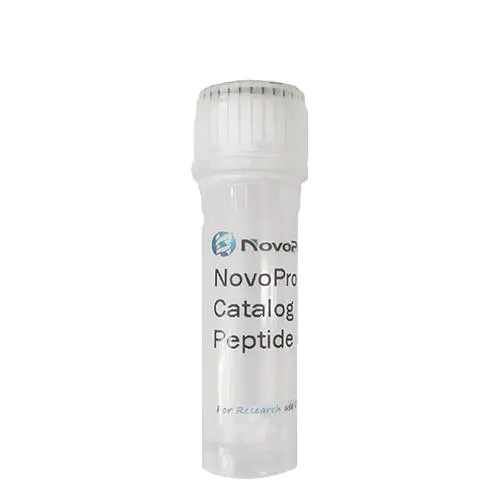
LPCL peptide
Not For Human Use, Lab Use Only.
Cat.#: 319754
Special Price 162.70 USD
Availability:
1-2 weeks
-
Product Name
LPCL peptide
-
Documents
Batch to batch variation of the purity
-
Sequence Shortening
H-LPCL-OH
-
Sequence
H-Leu-Pro-Cys-Leu-OH
-
Length (aa)
4
-
Peptide Purity (HPLC)
95.88%
-
Molecular Formula
C20H36N4O5S
-
Molecular Weight
444.59
-
Source
Synthetic
-
Form
Powder
-
Description
- LPCL is a polypeptide with significant potential in the field of health and medicine. It has been identified as a promising inhibitor of dipeptidyl peptidase IV (DPP-IV). This polypeptide exhibits favorable pharmacokinetic properties, suggesting its potential for effective utilization within the body.
- In vitro studies have demonstrated that LPCL shows potent inhibitory activity against DPP-IV. It has an IC50 value of 76.56 ± 3.17μM, and it functions as a competitive inhibitor. Through various interactions such as electrostatic, π-stacking, hydrogen, and hydrophobic interactions with the DPP-IV catalytic triad, LPCL can effectively bind to the enzyme. Additionally, in situ experiments have shown that LPCL can significantly reduce the DPP-IV activity in STC-1 cells to 27.40 ± 2.88%, with a relatively low IC50 value of 481.6μM. Importantly, LPCL treatment has been shown to increase the levels of active GLP-1, which is crucial for glucose homeostasis. Overall, LPCL holds great promise as a potential agent for the management of conditions related to DPP-IV activity, such as type-2 diabetes mellitus.
-
Storage Guidelines
Normally, this peptide will be delivered in lyophilized form and should be stored in a freezer at or below -20 °C. For more details, please refer to the manual: Handling and Storage of Synthetic Peptides
-
References
- Rhessa Grace Guanga Ortizo, Vishal Sharma, Mei-Ling Tsai, Parushi Nargotra, Pei-Pei Sun, Chiu Wen Chen, Cheng-Di Dong, Integrating in silico, in vitro, and in situ approaches for characterization of novel peptides from tilapia (Oreochromis niloticus) viscera hydrolysates with dipeptidyl-peptidase IV inhibitory activity, Food Bioscience, Volume 63, 2025, 105619, ISSN 2212-4292, doi: org/10.1016/j.fbio.2024.105619.
-
About TFA salt
Trifluoroacetic acid (TFA) is a common counterion from the purification process using High-Performance Liquid Chromatography (HPLC). The presence of TFA can affect the peptide's net weight, appearance, and solubility.
Impact on Net Weight: The TFA salt contributes to the total mass of the product. In most cases, the peptide content constitutes >80% of the total weight, with TFA accounting for the remainder.
Solubility: TFA salts generally enhance the solubility of peptides in aqueous solutions.
In Biological Assays: For most standard in vitro assays, the residual TFA levels do not cause interference. However, for highly sensitive cellular or biochemical studies, please be aware of its presence.
-
Molar Concentration Calculator
-
Dilution Calculator
-
Percent Concentration Calculator
Mass (g) = Concentration (mol/L) × Volume (L) × Molecular Weight (g/mol)
Related Products / Services
• Peptide Services: NovoPro's peptide synthesis services include standard chemical peptide synthesis, peptide modification, peptide libraries, and recombinant peptide expression.
• Standard Peptide Synthesis: NovoPro offers quality peptides at the most competitive prices in the industry, starting at $3.20 per amino acid. NovoPro provides PepBox – Automatic Quote Tool for online price calculation.
• Peptide Modifications: NovoPro offers a wide range of peptide modification services including isotope labeling (2H, 15N, and 13C), multiple disulfide bonds, multiple phosphorylations, KLH, BSA, ovalbumin, amidation, acetylation, biotin, FITC, etc.
Please note: All products are "FOR RESEARCH USE ONLY AND ARE NOT INTENDED FOR DIAGNOSTIC OR THERAPEUTIC USE"