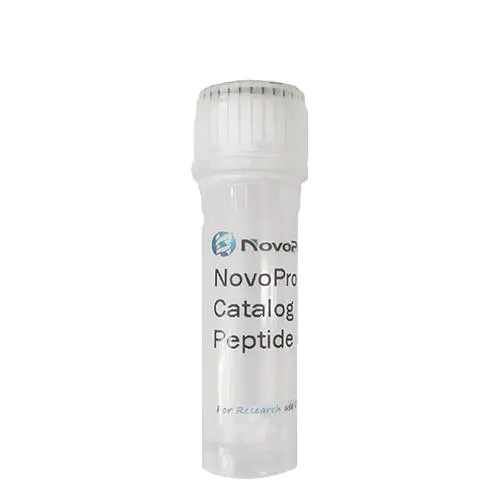
CTT peptide
Not For Human Use, Lab Use Only.
Cat.#: 308542
Special Price 236.50 USD
Availability:
1-2 weeks
-
Product Name
CTT peptide
-
Documents
Batch to batch variation of the purity
-
Sequence Shortening
CTTHWGFTLC
-
Sequence
H-Cys-Thr-Thr-His-Trp-Gly-Phe-Thr-Leu-Cys-OH (Disulfide bond)
-
Length (aa)
10
-
Peptide Purity (HPLC)
97.8%
-
Molecular Formula
C52H71N13O14S2
-
Molecular Weight
1166.35
-
Source
Synthetic
-
Form
Powder
-
Description
Matrix metalloproteinase 2 (MMP2 or gelatinase A), MMP9 (gelatinase B) and other MMPs including collagenases, stromelysins, and the membrane-type MMPs belong to a large family of endopeptidases involved in the degradation of extracellular matrix (ECM) proteins constituting the basement membrane barrier as well as cleavage of growth factor precursors, receptor tyrosine kinases, cell adhesion molecules, and other proteins. MMPs are involved in tumor growth, migration, invasion, and metastases as well as angiogenesis and tissue remodeling. Interestingly, MMP9 expression in the stromal cells but not in the breast cancer cells associated with poor prognosis. In an attempt to develop peptide-based gelatinase inhibitors to attenuate cancer progression, an in vitro phage display screen with purified MMP9 using a random peptide (CX5-8C) library was used to identify two cyclic decapeptides (CTTHWGFTLC (CTT) and CRRHWGFEFC) targeting MMP2 and MMP9. These peptides share the HWGF domain. The inhibitory effect of the peptides was analyzed in a 125I-gelatin degradation assay. CTT or CRRHWGFEFC inhibited the MMP9 activity with micromolar IC50 values while the control peptide (GACLRSGRGCGA) showed negligible effect. CTT also inhibited MMP2 with IC50 of 10 uM. CTT inhibits specifically the MMP2 and MMP9 activity while no inhibitory activity against MT1-MMP, MM8 or MM13 was detected. As a further modification, a CTT derived retro inverso peptide (D amino acids except glycine, L-Gly) was generated (cltfGwhttc) and it showed better inhibitory effect against MMP2 than the original CTT in vitro. However, it was not studied further due to its poor water solubility. When the gelatinase targeting CTT peptide was developed for radioimaging, it lost the inhibitory activity after conjugation to 125I, but not when conjugated to Technetium- 99m. Thus, the N-terminus of CTT was modified by the addition of two alanine and one tyrosine residues (AAY-CTT) followed by labeling with 125I (125I-AAY-CTT) to restore the inhibitory activity. The 125I-AAY-CTT as well as the CTT coated 125I-BSA encapsulated liposomes accumulated to the KS1767 Kaposi’s sarcoma tumors following the intravenous injections, unlike their non-targeting controls with some indication of homing also to metastatic lesions in the lung. In another study, CTT peptide conjugated to 64Cu through a DOPA (1,4,7,10-Tetraazacyclododecane- 1,4,7,10) chelator was tested in PET imaging. Even though the Cu (II)- DOTA-CTT inhibited MMP2 and MMP9 activities with binding affinities (EC50) of 8.7 uM and 18.2 uM, respectively, which are very similar to those of the original CTT (13.2 uM and 11.0 uM, respectively), it was not successful in in vivo tumor imaging. Stability and the gelatinase inhibition activity of the CTT peptide was increased by substituting the disulfide bond with an amide bond to form a c(KAHWGFTLD)NH2 peptide (C6). Cy5.5 fluorescein conjugated to the C6 peptide was taken up by MMP-2 expressing glioma cells in vitro and homed to both intratibial PC-3 prostate xenografts and orthotopic U87 glioma xenografts in vivo. In addition, C6 peptide conjugated to NOTA (1,4,7,10-Triazacyclononanetriacetic acid) chelator and radiolabeled with 68Ga (68Ga-NOTAC6) showed accumulation of the conjugate in subcutaneous ovarian cancer (SKOV3) xenografts. Several studies have since utilized CTT as an MMP2 inhibitor as vasorelaxant and imaging of gelatinase activity in tumors.
-
Storage Guidelines
Normally, this peptide will be delivered in lyophilized form and should be stored in a freezer at or below -20 °C. For more details, please refer to the manual: Handling and Storage of Synthetic Peptides
-
References
- E.Koivunen et al., Nat. Biotechnol., 17, 768 (1999)
-
About TFA salt
Trifluoroacetic acid (TFA) is a common counterion from the purification process using High-Performance Liquid Chromatography (HPLC). The presence of TFA can affect the peptide's net weight, appearance, and solubility.
Impact on Net Weight: The TFA salt contributes to the total mass of the product. In most cases, the peptide content constitutes >80% of the total weight, with TFA accounting for the remainder.
Solubility: TFA salts generally enhance the solubility of peptides in aqueous solutions.
In Biological Assays: For most standard in vitro assays, the residual TFA levels do not cause interference. However, for highly sensitive cellular or biochemical studies, please be aware of its presence.
-
Molar Concentration Calculator
-
Dilution Calculator
-
Percent Concentration Calculator
Mass (g) = Concentration (mol/L) × Volume (L) × Molecular Weight (g/mol)
Peptide Property
- Analysed Sequence:H-CTTHWGFTLC-OH
- Chemical Formula:C52H71N13O14S2
- Sequence length:10
- Extinction coefficient:5810 M-1cm-1
- GRAVY:0.5
- Mw average:1166.32
- Theoretical pI:7
- Data Source:Peptide Property Calculator
GRAVY = grand average of hydropathy
X: Hydrophobic uncharged residues, like F I L M V W A and P
X: Basic residues, like R K H
X: Acidic residues, like D E
X: Polar uncharged residues, like G S T C N Q and Y
Related Products / Services
• Peptide Services: NovoPro's peptide synthesis services include standard chemical peptide synthesis, peptide modification, peptide libraries, and recombinant peptide expression.
• Standard Peptide Synthesis: NovoPro offers quality peptides at the most competitive prices in the industry, starting at $3.20 per amino acid. NovoPro provides PepBox – Automatic Quote Tool for online price calculation.
• Peptide Modifications: NovoPro offers a wide range of peptide modification services including isotope labeling (2H, 15N, and 13C), multiple disulfide bonds, multiple phosphorylations, KLH, BSA, ovalbumin, amidation, acetylation, biotin, FITC, etc.
Please note: All products are "FOR RESEARCH USE ONLY AND ARE NOT INTENDED FOR DIAGNOSTIC OR THERAPEUTIC USE"