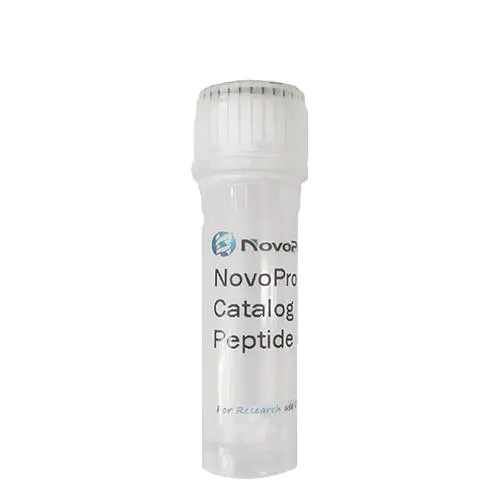
GIP (1-42), human peptide
Not For Human Use, Lab Use Only.
Cat.#: 318995
Special Price 510.40 USD
Availability:
5 working days
-
Product Name
GIP (1-42), human peptide
-
Documents
Batch to batch variation of the purity
-
Sequence Shortening
H-YAEGTFISDYSIAMDKIHQQDFVNWLLAQKGKKNDWKHNITQ-OH
-
Sequence
H-Tyr-Ala-Glu-Gly-Thr-Phe-Ile-Ser-Asp-Tyr-Ser-Ile-Ala-Met-Asp-Lys-Ile-His-Gln-Gln-Asp-Phe-Val-Asn-Trp-Leu-Leu-Ala-Gln-Lys-Gly-Lys-Lys-Asn-Asp-Trp-Lys-His-Asn-Ile-Thr-Gln-OH
-
Length (aa)
42
-
Peptide Purity (HPLC)
95.26%
-
Molecular Formula
C226H338N60O66S
-
Molecular Weight
4983.57
-
CAS No.
100040-31-1
-
Source
Synthetic
-
Form
Powder
-
Description
Gastric Inhibitory Polypeptide (GIP), also known as Glucose-Dependent Insulinotropic Polypeptide, is a 42-amino acid peptide hormone secreted by K-cells in the proximal small intestine. Its secretion is primarily stimulated by the ingestion of carbohydrate- and lipid-rich meals. GIP functions as a major incretin hormone, meaning it potentiates glucose-stimulated insulin secretion from pancreatic beta-cells in a glucose-dependent manner, playing a significant role in postprandial glucose homeostasis. The biological activity of the intact GIP [1-42 amide] is rapidly terminated by enzymatic cleavage by dipeptidyl-peptidase IV (DPP IV), which yields the inactive metabolite GIP [3-42 amide].
Beyond its insulinotropic role, GIP exerts peripheral effects on adipose tissue and lipid metabolism. It stimulates lipoprotein lipase activity in adipocytes and promotes fatty acid synthesis and incorporation into adipose tissue, indicating a role in postprandial lipid deposition. GIP receptors are present on adipocytes, and receptor activation leads to increased intracellular cAMP production. While early studies suggested inhibitory effects on gastric acid secretion, subsequent research with physiological doses of human GIP indicates these gastrointestinal effects are negligible in humans.
-
Storage Guidelines
Normally, this peptide will be delivered in lyophilized form and should be stored in a freezer at or below -20 °C. For more details, please refer to the manual: Handling and Storage of Synthetic Peptides
-
References
- Wheeler et al (1995) Functional expression of the rat pancreatic islet glucose-dependent Insotropic polypeptide receptor: ligand binding and intracellular signaling properties. Endocrinol. 136 4629 PMID: 7664683
- Meier et al (2002) Gastric inhibitory polypeptide: the neglected incretin revisited. Regul.Peptides 107 1 PMID: 12137960
- Hansen et al (2016) N-terminally and C-terminally truncated forms of glucose-dependent insulinotropic polypeptide are high-affinity competitive antagonists of the human GIP receptor. Br. J. Pharmacol. 173 826 PMID: 26572091
-
About TFA salt
Trifluoroacetic acid (TFA) is a common counterion from the purification process using High-Performance Liquid Chromatography (HPLC). The presence of TFA can affect the peptide's net weight, appearance, and solubility.
Impact on Net Weight: The TFA salt contributes to the total mass of the product. In most cases, the peptide content constitutes >80% of the total weight, with TFA accounting for the remainder.
Solubility: TFA salts generally enhance the solubility of peptides in aqueous solutions.
In Biological Assays: For most standard in vitro assays, the residual TFA levels do not cause interference. However, for highly sensitive cellular or biochemical studies, please be aware of its presence.
-
Molar Concentration Calculator
-
Dilution Calculator
-
Percent Concentration Calculator
Mass (g) = Concentration (mol/L) × Volume (L) × Molecular Weight (g/mol)
Related Products / Services
• Peptide Services: NovoPro's peptide synthesis services include standard chemical peptide synthesis, peptide modification, peptide libraries, and recombinant peptide expression.
• Standard Peptide Synthesis: NovoPro offers quality peptides at the most competitive prices in the industry, starting at $3.20 per amino acid. NovoPro provides PepBox – Automatic Quote Tool for online price calculation.
• Peptide Modifications: NovoPro offers a wide range of peptide modification services including isotope labeling (2H, 15N, and 13C), multiple disulfide bonds, multiple phosphorylations, KLH, BSA, ovalbumin, amidation, acetylation, biotin, FITC, etc.
Please note: All products are "FOR RESEARCH USE ONLY AND ARE NOT INTENDED FOR DIAGNOSTIC OR THERAPEUTIC USE"