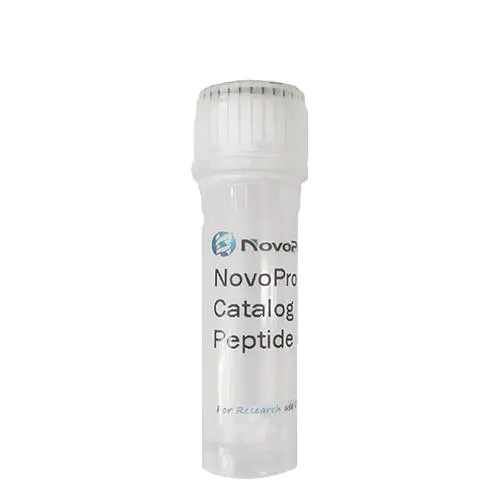
GGACK peptide
Not For Human Use, Lab Use Only.
Cat.#: 319812
Special Price 301.70 USD
Availability:
1-2 weeks
-
Product Name
GGACK peptide
-
Documents
Batch to batch variation of the purity
-
Sequence Shortening
EGR-{CMK}
-
Sequence
Glu-Gly-Arg-{CMK}
-
Length (aa)
3
-
Peptide Purity (HPLC)
95.93%
-
Molecular Formula
C14H25ClN6O5
-
Molecular Weight
392.84
-
CAS No.
65113-67-9
-
Source
Synthetic
-
Form
Powder
-
Description
The GGACK peptide, specifically H-Glu-Gly-Arg-chloromethylketone, is a synthetic tripeptide chloromethylketone inhibitor that targets serine proteases with trypsin-like specificity. Its structure includes a glutamic acid (Glu) residue at the P3 position, glycine (Gly) at P2, and an arginine (Arg) derivative at P1, with a chloromethylketone moiety covalently modifying the active-site histidine residue. This irreversible inhibition mechanism has been instrumental in structural studies, as demonstrated by its use in crystallizing the urokinase-type plasminogen activator (uPA) complex, revealing key interactions within the enzyme's active site.
The peptide's binding mode involves insertion of the arginine side chain into the S1 pocket of uPA, forming a salt bridge with Asp-189, while the chloromethylketone group alkylates His-57, rendering the enzyme inactive. The Glu-Gly-Arg sequence aligns with uPA's substrate preference, and the chloromethylketone modification provides a stable, covalent adduct for X-ray crystallography. This structural insight has facilitated the design of other arginine-mimetic inhibitors targeting serine proteases.
-
Storage Guidelines
Normally, this peptide will be delivered in lyophilized form and should be stored in a freezer at or below -20 °C. For more details, please refer to the manual: Handling and Storage of Synthetic Peptides
-
References
- Sperl S, Jacob U, Arroyo de Prada N, Stürzebecher J, Wilhelm OG, Bode W, Magdolen V, Huber R, Moroder L. (4-aminomethyl)phenylguanidine derivatives as nonpeptidic highly selective inhibitors of human urokinase. Proc Natl Acad Sci U S A. 2000 May 9;97(10):5113-8. doi: 10.1073/pnas.97.10.5113. PMID: 10805774; PMCID: PMC25790.
-
About TFA salt
Trifluoroacetic acid (TFA) is a common counterion from the purification process using High-Performance Liquid Chromatography (HPLC). The presence of TFA can affect the peptide's net weight, appearance, and solubility.
Impact on Net Weight: The TFA salt contributes to the total mass of the product. In most cases, the peptide content constitutes >80% of the total weight, with TFA accounting for the remainder.
Solubility: TFA salts generally enhance the solubility of peptides in aqueous solutions.
In Biological Assays: For most standard in vitro assays, the residual TFA levels do not cause interference. However, for highly sensitive cellular or biochemical studies, please be aware of its presence.
-
Molar Concentration Calculator
-
Dilution Calculator
-
Percent Concentration Calculator
Mass (g) = Concentration (mol/L) × Volume (L) × Molecular Weight (g/mol)
Related Products / Services
• Peptide Services: NovoPro's peptide synthesis services include standard chemical peptide synthesis, peptide modification, peptide libraries, and recombinant peptide expression.
• Standard Peptide Synthesis: NovoPro offers quality peptides at the most competitive prices in the industry, starting at $3.20 per amino acid. NovoPro provides PepBox – Automatic Quote Tool for online price calculation.
• Peptide Modifications: NovoPro offers a wide range of peptide modification services including isotope labeling (2H, 15N, and 13C), multiple disulfide bonds, multiple phosphorylations, KLH, BSA, ovalbumin, amidation, acetylation, biotin, FITC, etc.
Please note: All products are "FOR RESEARCH USE ONLY AND ARE NOT INTENDED FOR DIAGNOSTIC OR THERAPEUTIC USE"