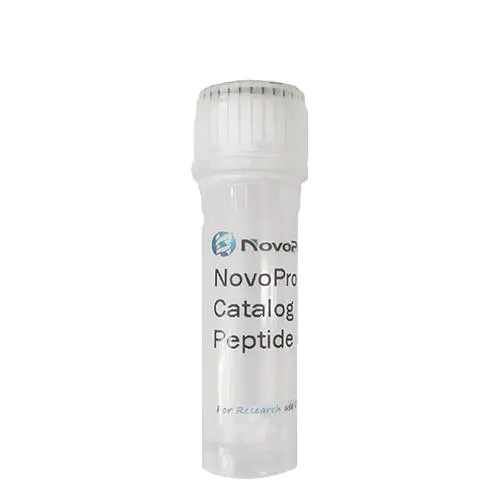
CXCL9(74–103) peptide
Not For Human Use, Lab Use Only.
Cat.#: 318983
Special Price 254.80 USD
Availability:
4 weeks
-
Product Name
CXCL9(74–103) peptide
-
Documents
Batch to batch variation of the purity
-
Sequence Shortening
H-KKKQKNGKKHQKKKVLKVRKSQRSRQKKTT-OH
-
Sequence
H-Lys-Lys-Lys-Gln-Lys-Asn-Gly-Lys-Lys-His-Gln-Lys-Lys-Lys-Val-Leu-Lys-Val-Arg-Lys-Ser-Gln-Arg-Ser-Arg-Gln-Lys-Lys-Thr-Thr-OH
-
Length (aa)
30
-
Peptide Purity (HPLC)
95.28%
-
Molecular Formula
C158H295N59O40
-
Molecular Weight
3661.39
-
Source
Synthetic
-
Form
Powder
-
Description
CXCL9(74–103) is a peptide corresponding to the C-terminal amino acids of the chemokine CXCL9. CXCL9(74–103) does not signal through or act as an antagonist for CXCR3, the CXCL9 receptor, or influence the neutrophil chemotactic activity of CXCL8 in vitro, but it does display high affinity for glycosaminoglycans (GAGs), and can displace chemokines bound to GAGs. CXCL8 and CXCL9 drive leukocyte migration to inflammation sites and through this inhibition of the chemokine-GAG interaction, CXCL9(74–103) can block neutrophil migration. In vivo, CXCL9(74-103) ameliorates joint inflammation in a murine model of antigen induced arthritis, reducing neutrophil accumulation and joint and cartilage damage, and is also effective in a murine model of gout.
-
Storage Guidelines
Normally, this peptide will be delivered in lyophilized form and should be stored in a freezer at or below -20 °C. For more details, please refer to the manual: Handling and Storage of Synthetic Peptides
-
References
- Vanheule et al (2015) The Positively Charged COOH-terminal Glycosaminoglycan-binding CXCL9(74-103) Peptide Inhibits CXCL8-induced Neutrophil Extravasation and Monosodium Urate Crystal-induced Gout in Mice. J Biol Chem. 290(35) 21292 PMID: 26183778
- Boff (2018) The chemokine fragment CXCL9(74-103) diminishes neutrophil recruitment and joint inflammation in antigen-induced arthritis. J Leukoc Biol. 104(2) 413 PMID: 29733455
- De Zutter et al (2021) The Chemokine-Based Peptide, CXCL9(74-103), Inhibits Angiogenesis by Blocking Heparan Sulfate Proteoglycan-Mediated Signaling of Multiple Endothelial Growth Factors. Cancers 13(20) 5090 PMID: 34680238
-
About TFA salt
Trifluoroacetic acid (TFA) is a common counterion from the purification process using High-Performance Liquid Chromatography (HPLC). The presence of TFA can affect the peptide's net weight, appearance, and solubility.
Impact on Net Weight: The TFA salt contributes to the total mass of the product. In most cases, the peptide content constitutes >80% of the total weight, with TFA accounting for the remainder.
Solubility: TFA salts generally enhance the solubility of peptides in aqueous solutions.
In Biological Assays: For most standard in vitro assays, the residual TFA levels do not cause interference. However, for highly sensitive cellular or biochemical studies, please be aware of its presence.
-
Molar Concentration Calculator
-
Dilution Calculator
-
Percent Concentration Calculator
Mass (g) = Concentration (mol/L) × Volume (L) × Molecular Weight (g/mol)
Related Products / Services
• Peptide Services: NovoPro's peptide synthesis services include standard chemical peptide synthesis, peptide modification, peptide libraries, and recombinant peptide expression.
• Standard Peptide Synthesis: NovoPro offers quality peptides at the most competitive prices in the industry, starting at $3.20 per amino acid. NovoPro provides PepBox – Automatic Quote Tool for online price calculation.
• Peptide Modifications: NovoPro offers a wide range of peptide modification services including isotope labeling (2H, 15N, and 13C), multiple disulfide bonds, multiple phosphorylations, KLH, BSA, ovalbumin, amidation, acetylation, biotin, FITC, etc.
Please note: All products are "FOR RESEARCH USE ONLY AND ARE NOT INTENDED FOR DIAGNOSTIC OR THERAPEUTIC USE"