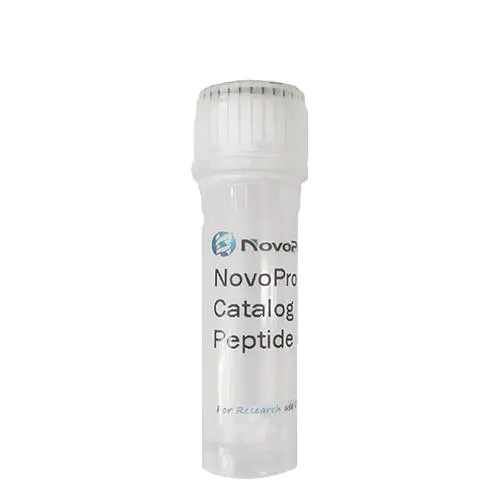
Conopeptide Vt3.1
Not For Human Use, Lab Use Only.
Cat.#: 304500
Special Price 659.60 USD
Availability:
5 working days
-
Product Name
Conopeptide Vt3.1
-
Documents
Batch to batch variation of the purity
-
Sequence Shortening
GPYRRYGNCYCPI-NH2 (disulfide-crosslinked dimer C9-C11)
-
Sequence
Gly-Pro-Tyr-Arg-Arg-Tyr-Gly-Asn-Cys-Tyr-Cys-Pro-Ile-NH2 (disulfide-crosslinked dimer C9-C11)
-
Length (aa)
13
-
Peptide Purity (HPLC)
97.69%
-
Molecular Formula
C138H195N41O34S4
-
Molecular Weight
3115.52
-
Source
Synthetic
-
Form
Powder
-
Description
Conopeptide Vt3.1 is a disulfide-cross-linked dimer identified from Conus vitulinus, characterized by its unique structure and preferential inhibition of BK potassium channels containing the β4 subunit. The peptide modulates channel activity by altering voltage-dependent gating, shifting the conductance-voltage relation by approximately 45 mV and reducing maximal conductance by up to 71%. Vt3.1 interacts with acidic residues in the extracellular loops of both the slo1 and β4 subunits via electrostatic interactions, highlighting a large interaction surface between these subunits. This specificity makes Vt3.1 a valuable tool for studying the structural and functional properties of BK channels, particularly those involving the β4 subunit.
Structurally, Vt3.1 lacks ordered secondary elements but adopts an L-shaped conformation with positively charged N-termini that facilitate its interaction with the channel. Unlike pore-blocking toxins, Vt3.1 influences voltage sensor movements and the coupling between voltage sensors and the pore, leading to altered activation kinetics. Its effects are rapid and reversible, further underscoring its utility in probing BK channel dynamics. The peptide's selectivity for β4-containing channels, which are predominantly expressed in neuronal tissues, provides insights into the role of auxiliary subunits in modulating BK channel function.
-
Storage Guidelines
Normally, this peptide will be delivered in lyophilized form and should be stored in a freezer at or below -20 °C. For more details, please refer to the manual: Handling and Storage of Synthetic Peptides
-
References
- Li M, Chang S, Yang L, Shi J, McFarland K, Yang X, Moller A, Wang C, Zou X, Chi C, Cui J. Conopeptide Vt3.1 preferentially inhibits BK potassium channels containing β4 subunits via electrostatic interactions. J Biol Chem. 2014 Feb 21;289(8):4735-42. doi: 10.1074/jbc.M113.535898. Epub 2014 Jan 7. PMID: 24398688; PMCID: PMC3931035.
- Wu XC, Zhou M, Peng C, Shao XX, Guo ZY, Chi CW. Novel conopeptides in a form of disulfide-crosslinked dimer. Peptides. 2010 Jun;31(6):1001-6. doi: 10.1016/j.peptides.2010.03.010. Epub 2010 Mar 20. PMID: 20307606.
-
About TFA salt
Trifluoroacetic acid (TFA) is a common counterion from the purification process using High-Performance Liquid Chromatography (HPLC). The presence of TFA can affect the peptide's net weight, appearance, and solubility.
Impact on Net Weight: The TFA salt contributes to the total mass of the product. In most cases, the peptide content constitutes >80% of the total weight, with TFA accounting for the remainder.
Solubility: TFA salts generally enhance the solubility of peptides in aqueous solutions.
In Biological Assays: For most standard in vitro assays, the residual TFA levels do not cause interference. However, for highly sensitive cellular or biochemical studies, please be aware of its presence.
-
Molar Concentration Calculator
-
Dilution Calculator
-
Percent Concentration Calculator
Mass (g) = Concentration (mol/L) × Volume (L) × Molecular Weight (g/mol)
Related Products / Services
• Peptide Services: NovoPro's peptide synthesis services include standard chemical peptide synthesis, peptide modification, peptide libraries, and recombinant peptide expression.
• Standard Peptide Synthesis: NovoPro offers quality peptides at the most competitive prices in the industry, starting at $3.20 per amino acid. NovoPro provides PepBox – Automatic Quote Tool for online price calculation.
• Peptide Modifications: NovoPro offers a wide range of peptide modification services including isotope labeling (2H, 15N, and 13C), multiple disulfide bonds, multiple phosphorylations, KLH, BSA, ovalbumin, amidation, acetylation, biotin, FITC, etc.
Please note: All products are "FOR RESEARCH USE ONLY AND ARE NOT INTENDED FOR DIAGNOSTIC OR THERAPEUTIC USE"