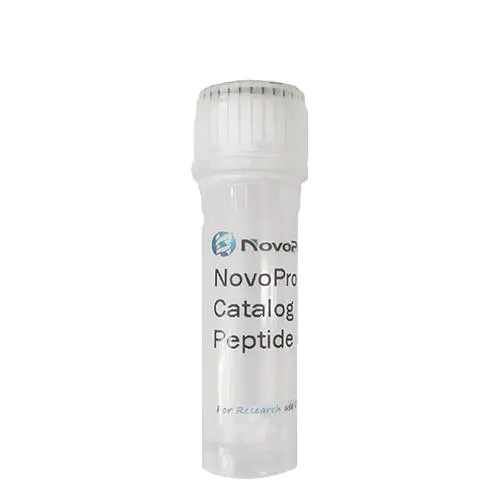
Cholecystokinin peptide
Not For Human Use, Lab Use Only.
Cat.#: 315304
Special Price 1,101.20 USD
Availability:
4 weeks
-
Product Name
Cholecystokinin peptide
-
Documents
Batch to batch variation of the purity
-
Sequence Shortening
KAPSGRMSIVKNLQNLDPSHRISDRD-{Tyr(SO3H)}-MGWMDF-NH2
-
Sequence
Lys-Ala-Pro-Ser-Gly-Arg-Met-Ser-Ile-Val-Lys-Asn-Leu-Gln-Asn-Leu-Asp-Pro-Ser-His-Arg-Ile-Ser-Asp-Arg-Asp-{Tyr(SO3H)}-Met-Gly-Trp-Met-Asp-Phe-NH2
-
Length (aa)
33
-
Peptide Purity (HPLC)
96.3%
-
Molecular Formula
C167H263N51O52S4
-
Molecular Weight
3945.45
-
CAS No.
9011-97-6
-
PubChem CID
16129670
-
Source
Synthetic
-
Form
Powder
-
Description
Cholecystokinin (CCK) is a peptide hormone released by intestinal I-cells in response to dietary lipids and proteins, mediated through G-protein-coupled receptors GPR40 and calcium-sensing receptor (CaSR). CCK plays a key role in regulating nutrient delivery by inhibiting food intake and gastric emptying, primarily through its action on vagal afferent neurons. These neurons integrate peripheral signals, with CCK modulating the expression of receptors and peptide neurotransmitters, such as cocaine and amphetamine-regulated transcript (CART), in a manner influenced by leptin and ghrelin.
Functional studies reveal that CCK activates brainstem, hypothalamic, and cortical regions, as demonstrated by fMRI responses to lipid ingestion. The hormone also exhibits plasticity in vagal afferent signaling, with its effects attenuated in obesity due to decreased neuronal excitability. Beyond its neural actions, CCK contributes to pancreatic islet function, potentially influencing β-cell mass and insulin release under specific conditions.
-
Storage Guidelines
Normally, this peptide will be delivered in lyophilized form and should be stored in a freezer at or below -20 °C. For more details, please refer to the manual: Handling and Storage of Synthetic Peptides
-
References
- Dockray GJ. Cholecystokinin. Curr Opin Endocrinol Diabetes Obes. 2012 Feb;19(1):8-12. doi: 10.1097/MED.0b013e32834eb77d. PMID: 22157397.
-
About TFA salt
Trifluoroacetic acid (TFA) is a common counterion from the purification process using High-Performance Liquid Chromatography (HPLC). The presence of TFA can affect the peptide's net weight, appearance, and solubility.
Impact on Net Weight: The TFA salt contributes to the total mass of the product. In most cases, the peptide content constitutes >80% of the total weight, with TFA accounting for the remainder.
Solubility: TFA salts generally enhance the solubility of peptides in aqueous solutions.
In Biological Assays: For most standard in vitro assays, the residual TFA levels do not cause interference. However, for highly sensitive cellular or biochemical studies, please be aware of its presence.
-
Molar Concentration Calculator
-
Dilution Calculator
-
Percent Concentration Calculator
Mass (g) = Concentration (mol/L) × Volume (L) × Molecular Weight (g/mol)
Related Products / Services
• Peptide Services: NovoPro's peptide synthesis services include standard chemical peptide synthesis, peptide modification, peptide libraries, and recombinant peptide expression.
• Standard Peptide Synthesis: NovoPro offers quality peptides at the most competitive prices in the industry, starting at $3.20 per amino acid. NovoPro provides PepBox – Automatic Quote Tool for online price calculation.
• Peptide Modifications: NovoPro offers a wide range of peptide modification services including isotope labeling (2H, 15N, and 13C), multiple disulfide bonds, multiple phosphorylations, KLH, BSA, ovalbumin, amidation, acetylation, biotin, FITC, etc.
Please note: All products are "FOR RESEARCH USE ONLY AND ARE NOT INTENDED FOR DIAGNOSTIC OR THERAPEUTIC USE"