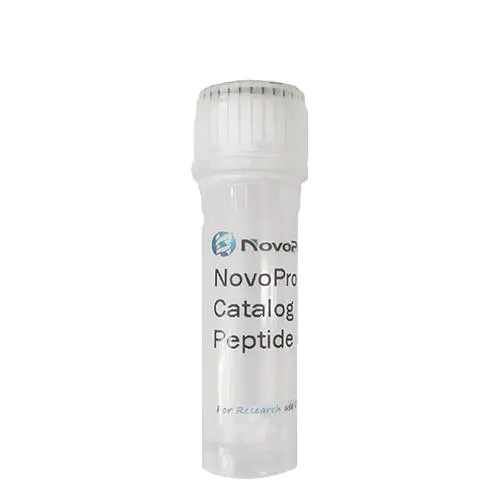
alpha-MSH (11-13)/KPV peptide
Not For Human Use, Lab Use Only.
Cat.#: 306810
Special Price 145.70 USD
Availability:
5 working days
-
Product Name
alpha-MSH (11-13)/KPV peptide
-
Documents
Batch to batch variation of the purity
-
Sequence Shortening
KPV
-
Sequence
H-Lys-Pro-Val-OH
-
Length (aa)
3
-
Peptide Purity (HPLC)
96.44%
-
Molecular Formula
C16H30N4O4
-
Molecular Weight
342.43
-
Source
Synthetic
-
Form
Powder
-
Description
KPV is a C-terminal peptide fragment of α-MSH. It is highly hydrophilic and has poor skin penetration. KPV exhibits potent anti-inflammatory effects by binding to melanocortin receptors (MC-Rs) in the skin. The anti-inflammatory activity of α-MSH is mediated by the three terminal amino acids, Lysine-Proline-Valine (KPV). KPV lacks the entire sequence motif required for binding to the MC-Rs, but still retains full anti-inflammatory effect of the parent hormone. The inflammatory activity of KPV is suggested to be mediated via inhibition of interleukin (IL)-1β. Unlike α-MSH, KPV is free from the melanotropic effects and thus does not cause any pigmentation. Additionally, it is smaller in size and more chemically stable than α-MSH. Recently albumin based KPV nanoparticles were targeted to the colon with polysaccharide hydrogel reduce inflammatory bowel disease in a mouse model. It has also been reported that KPV suppresses NFkB signaling, inhibits p65RelA nuclear import and activates epithelial MC3Rs in the airway inflammation in lung disease. Hence KPV may be a suitable candidate for the treatment of inflammatory skin disorders.
-
Storage Guidelines
Normally, this peptide will be delivered in lyophilized form and should be stored in a freezer at or below -20 °C. For more details, please refer to the manual: Handling and Storage of Synthetic Peptides
-
References
- S.J.Getting et al., J. Pharmacol. Exp. Ther., 306, 631 (2003)
- G.Dalmasso et al., Gastroenterology, 134, 166 (2008)
- Pawar K, Kolli CS, Rangari VK, Babu RJ. Transdermal Iontophoretic Delivery of Lysine-Proline-Valine (KPV) Peptide Across Microporated Human Skin. J Pharm Sci. 2017 Jul;106(7):1814-1820. doi: 10.1016/j.xphs.2017.03.017. Epub 2017 Mar 24. PMID: 28343991.
-
About TFA salt
Trifluoroacetic acid (TFA) is a common counterion from the purification process using High-Performance Liquid Chromatography (HPLC). The presence of TFA can affect the peptide's net weight, appearance, and solubility.
Impact on Net Weight: The TFA salt contributes to the total mass of the product. In most cases, the peptide content constitutes >80% of the total weight, with TFA accounting for the remainder.
Solubility: TFA salts generally enhance the solubility of peptides in aqueous solutions.
In Biological Assays: For most standard in vitro assays, the residual TFA levels do not cause interference. However, for highly sensitive cellular or biochemical studies, please be aware of its presence.
-
Molar Concentration Calculator
-
Dilution Calculator
-
Percent Concentration Calculator
Mass (g) = Concentration (mol/L) × Volume (L) × Molecular Weight (g/mol)
Related Products / Services
• Peptide Services: NovoPro's peptide synthesis services include standard chemical peptide synthesis, peptide modification, peptide libraries, and recombinant peptide expression.
• Standard Peptide Synthesis: NovoPro offers quality peptides at the most competitive prices in the industry, starting at $3.20 per amino acid. NovoPro provides PepBox – Automatic Quote Tool for online price calculation.
• Peptide Modifications: NovoPro offers a wide range of peptide modification services including isotope labeling (2H, 15N, and 13C), multiple disulfide bonds, multiple phosphorylations, KLH, BSA, ovalbumin, amidation, acetylation, biotin, FITC, etc.
Please note: All products are "FOR RESEARCH USE ONLY AND ARE NOT INTENDED FOR DIAGNOSTIC OR THERAPEUTIC USE"