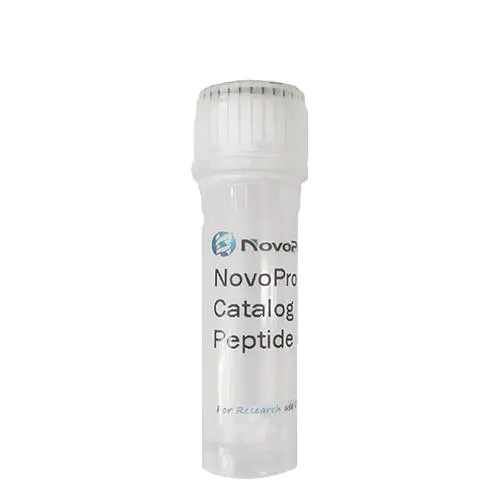
Ac9-25 peptide
Not For Human Use, Lab Use Only.
Cat.#: 319851
Special Price 187.20 USD
Availability:
5 working days
-
Product Name
Ac9-25 peptide
-
Documents
Batch to batch variation of the purity
-
Sequence Shortening
Ac-QAWFIENEEQEYVQTVK-OH
-
Sequence
Ac-Gln-Ala-Trp-Phe-Ile-Glu-Asn-Glu-Glu-Gln-Glu-Tyr-Val-Gln-Thr-Val-Lys-OH
-
Length (aa)
17
-
Peptide Purity (HPLC)
97.28%
-
Molecular Formula
C99H143N23O33
-
Molecular Weight
2183.36
-
CAS No.
284040-76-2
-
Source
Synthetic
-
Form
Powder
-
Description
The Ac9-25 peptide is a synthetic fragment derived from the N-terminal region of annexin A1, spanning amino acids 9 to 25. This peptide exhibits dual functionality in neutrophil signaling, activating the NADPH-oxidase through the formyl peptide receptor (FPR), but not through FPR-like 1 (FPRL1). The activation mechanism involves G protein-coupled receptor signaling, leading to superoxide anion release. Concurrently, Ac9-25 generates an inhibitory signal that suppresses NADPH-oxidase activity triggered by various chemoattractants, operating through a distinct receptor independent of the FPR family.
-
Storage Guidelines
Normally, this peptide will be delivered in lyophilized form and should be stored in a freezer at or below -20 °C. For more details, please refer to the manual: Handling and Storage of Synthetic Peptides
-
References
- Walther A, Riehemann K, Gerke V. A novel ligand of the formyl peptide receptor: annexin I regulates neutrophil extravasation by interacting with the FPR. Mol Cell. 2000 May;5(5):831-40. doi: 10.1016/s1097-2765(00)80323-8. PMID: 10882119.
- Karlsson J, Fu H, Boulay F, Dahlgren C, Hellstrand K, Movitz C. Neutrophil NADPH-oxidase activation by an annexin AI peptide is transduced by the formyl peptide receptor (FPR), whereas an inhibitory signal is generated independently of the FPR family receptors. J Leukoc Biol. 2005 Sep;78(3):762-71. doi: 10.1189/jlb.0305153. Epub 2005 Jun 10. PMID: 15951351.
-
About TFA salt
Trifluoroacetic acid (TFA) is a common counterion from the purification process using High-Performance Liquid Chromatography (HPLC). The presence of TFA can affect the peptide's net weight, appearance, and solubility.
Impact on Net Weight: The TFA salt contributes to the total mass of the product. In most cases, the peptide content constitutes >80% of the total weight, with TFA accounting for the remainder.
Solubility: TFA salts generally enhance the solubility of peptides in aqueous solutions.
In Biological Assays: For most standard in vitro assays, the residual TFA levels do not cause interference. However, for highly sensitive cellular or biochemical studies, please be aware of its presence.
-
Molar Concentration Calculator
-
Dilution Calculator
-
Percent Concentration Calculator
Mass (g) = Concentration (mol/L) × Volume (L) × Molecular Weight (g/mol)
Related Products / Services
• Peptide Services: NovoPro's peptide synthesis services include standard chemical peptide synthesis, peptide modification, peptide libraries, and recombinant peptide expression.
• Standard Peptide Synthesis: NovoPro offers quality peptides at the most competitive prices in the industry, starting at $3.20 per amino acid. NovoPro provides PepBox – Automatic Quote Tool for online price calculation.
• Peptide Modifications: NovoPro offers a wide range of peptide modification services including isotope labeling (2H, 15N, and 13C), multiple disulfide bonds, multiple phosphorylations, KLH, BSA, ovalbumin, amidation, acetylation, biotin, FITC, etc.
Please note: All products are "FOR RESEARCH USE ONLY AND ARE NOT INTENDED FOR DIAGNOSTIC OR THERAPEUTIC USE"