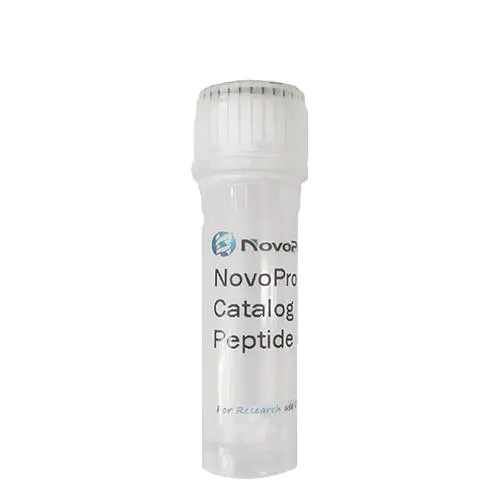
Kisspeptin-10 (human) peptide
Not For Human Use, Lab Use Only.
Cat.#: 307395
Special Price 187.80 USD
Availability:
5 working days
-
Product Name
Kisspeptin-10 (human) peptide
-
Documents
Batch to batch variation of the purity
-
Sequence Shortening
YNWNSFGLRF-NH2
-
Sequence
H-Tyr-Asn-Trp-Asn-Ser-Phe-Gly-Leu-Arg-Phe-NH2
-
Length (aa)
10
-
Peptide Purity (HPLC)
95.5%
-
Molecular Formula
C63H83N17O14
-
Molecular Weight
1302.45
-
CAS No.
374675-21-5
-
PubChem CID
25240297
-
Source
Synthetic
-
Form
Powder
-
Description
Kisspeptin-10 (KP-10) is a decapeptide derived from the proteolytic cleavage of the Kiss1 gene-encoded precursor protein. It binds to the G-protein-coupled receptor 54 (GPR54), initiating intracellular signaling cascades. KP-10 has been implicated in various biological processes, including embryonic kidney development and regulation of osteoblast differentiation. In mesenchymal stem cells, KP-10 enhances osteogenic gene expression, such as BMP2, Runx2, and Dlx5, through GPR54-mediated activation of NFATc4 transcription factor. This signaling pathway promotes Smad1/5/9 phosphorylation, a key step in BMP2-induced osteoblast differentiation.
The KP-10-GPR54 system plays a critical role in modulating BMP2 expression and its downstream osteogenic effects. KP-10 treatment significantly upregulates BMP2 mRNA and protein levels, leading to increased alkaline phosphatase (ALP) activity and mineralization in osteoblast precursor cells. Genetic ablation of GPR54 abolishes these effects, confirming the receptor's essential role in KP-10-induced osteogenic differentiation. The mechanism involves NFATc4 binding to the BMP2 promoter, establishing KP-10 as a regulator of bone formation through GPR54/NFATc4/BMP2 signaling.
-
Storage Guidelines
Normally, this peptide will be delivered in lyophilized form and should be stored in a freezer at or below -20 °C. For more details, please refer to the manual: Handling and Storage of Synthetic Peptides
-
References
- Son HE, Kim KM, Kim EJ, Jang WG. Kisspeptin-10 (KP-10) stimulates osteoblast differentiation through GPR54-mediated regulation of BMP2 expression and activation. Sci Rep. 2018 Feb 1;8(1):2134. doi: 10.1038/s41598-018-20571-2. PMID: 29391507; PMCID: PMC5794871.
-
About TFA salt
Trifluoroacetic acid (TFA) is a common counterion from the purification process using High-Performance Liquid Chromatography (HPLC). The presence of TFA can affect the peptide's net weight, appearance, and solubility.
Impact on Net Weight: The TFA salt contributes to the total mass of the product. In most cases, the peptide content constitutes >80% of the total weight, with TFA accounting for the remainder.
Solubility: TFA salts generally enhance the solubility of peptides in aqueous solutions.
In Biological Assays: For most standard in vitro assays, the residual TFA levels do not cause interference. However, for highly sensitive cellular or biochemical studies, please be aware of its presence.
-
Molar Concentration Calculator
-
Dilution Calculator
-
Percent Concentration Calculator
Mass (g) = Concentration (mol/L) × Volume (L) × Molecular Weight (g/mol)
Related Products / Services
• Peptide Services: NovoPro's peptide synthesis services include standard chemical peptide synthesis, peptide modification, peptide libraries, and recombinant peptide expression.
• Standard Peptide Synthesis: NovoPro offers quality peptides at the most competitive prices in the industry, starting at $3.20 per amino acid. NovoPro provides PepBox – Automatic Quote Tool for online price calculation.
• Peptide Modifications: NovoPro offers a wide range of peptide modification services including isotope labeling (2H, 15N, and 13C), multiple disulfide bonds, multiple phosphorylations, KLH, BSA, ovalbumin, amidation, acetylation, biotin, FITC, etc.
Please note: All products are "FOR RESEARCH USE ONLY AND ARE NOT INTENDED FOR DIAGNOSTIC OR THERAPEUTIC USE"