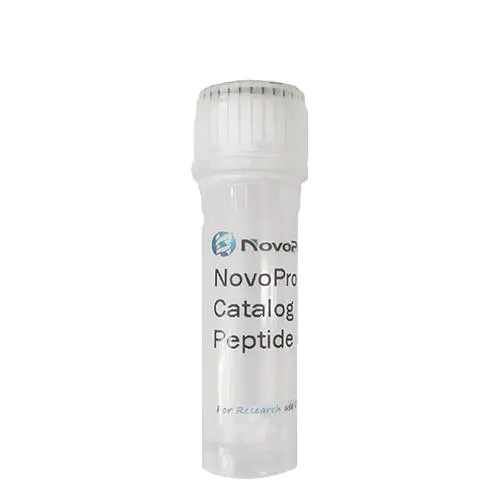
TAT-GluA2 3Y peptide
Not For Human Use, Lab Use Only.
Cat.#: 319829
Special Price 183.50 USD
Availability:
1-2 weeks
-
Product Name
TAT-GluA2 3Y peptide
-
Documents
Batch to batch variation of the purity
-
Sequence Shortening
H-YGRKKRRQRRRYKEGYNVYG-OH
-
Sequence
H-Tyr-Gly-Arg-Lys-Lys-Arg-Arg-Gln-Arg-Arg-Arg-Tyr-Lys-Glu-Gly-Tyr-Asn-Val-Tyr-Gly-OH
-
Length (aa)
20
-
Peptide Purity (HPLC)
95.3%
-
Molecular Formula
C115H185N43O29
-
Molecular Weight
2633.96
-
CAS No.
1404188-93-7
-
Source
Synthetic
-
Form
Powder
-
Description
The TAT-GluA2 3Y peptide is a synthetic interference peptide composed of 9 amino acids (YKEGYNVYG) linked to an HIV-1 Tat peptide (YGRKKRRQRRR) for blood-brain barrier penetration and cellular uptake. This peptide selectively disrupts the endocytosis of GluA2-containing AMPA receptors (AMPARs) by inhibiting the interaction between the GluA2 subunit and the clathrin-adaptor protein Brag2, which activates Arf6 to initiate receptor internalization. By blocking AMPAR endocytosis, TAT-GluA2 3Y prevents long-term depression (LTD) at glutamatergic synapses, a form of synaptic plasticity implicated in neural adaptations.
Studies demonstrate that TAT-GluA2 3Y administration attenuates neurochemical and behavioral responses associated with repeated psychostimulant exposure. Systemic delivery of the peptide during the induction phase of sensitization reduces dopamine efflux in the nucleus accumbens (NAcc) and blocks the maintenance of sensitized locomotor activity. Furthermore, intracerebral microinjection into the ventral tegmental area (VTA), but not the NAcc, inhibits the expression of sensitization, suggesting region-specific modulation of synaptic plasticity. These findings highlight the role of GluA2-containing AMPAR trafficking in neuroadaptations linked to associative learning processes.
-
Storage Guidelines
Normally, this peptide will be delivered in lyophilized form and should be stored in a freezer at or below -20 °C. For more details, please refer to the manual: Handling and Storage of Synthetic Peptides
-
References
- Choi FY, Ahn S, Wang YT, Phillips AG. Interference with AMPA receptor endocytosis: effects on behavioural and neurochemical correlates of amphetamine sensitization in male rats. J Psychiatry Neurosci. 2014 May;39(3):189-99. doi: 10.1503/jpn.120257. PMID: 24290077; PMCID: PMC3997604.
-
About TFA salt
Trifluoroacetic acid (TFA) is a common counterion from the purification process using High-Performance Liquid Chromatography (HPLC). The presence of TFA can affect the peptide's net weight, appearance, and solubility.
Impact on Net Weight: The TFA salt contributes to the total mass of the product. In most cases, the peptide content constitutes >80% of the total weight, with TFA accounting for the remainder.
Solubility: TFA salts generally enhance the solubility of peptides in aqueous solutions.
In Biological Assays: For most standard in vitro assays, the residual TFA levels do not cause interference. However, for highly sensitive cellular or biochemical studies, please be aware of its presence.
-
Molar Concentration Calculator
-
Dilution Calculator
-
Percent Concentration Calculator
Mass (g) = Concentration (mol/L) × Volume (L) × Molecular Weight (g/mol)
Related Products / Services
• Peptide Services: NovoPro's peptide synthesis services include standard chemical peptide synthesis, peptide modification, peptide libraries, and recombinant peptide expression.
• Standard Peptide Synthesis: NovoPro offers quality peptides at the most competitive prices in the industry, starting at $3.20 per amino acid. NovoPro provides PepBox – Automatic Quote Tool for online price calculation.
• Peptide Modifications: NovoPro offers a wide range of peptide modification services including isotope labeling (2H, 15N, and 13C), multiple disulfide bonds, multiple phosphorylations, KLH, BSA, ovalbumin, amidation, acetylation, biotin, FITC, etc.
Please note: All products are "FOR RESEARCH USE ONLY AND ARE NOT INTENDED FOR DIAGNOSTIC OR THERAPEUTIC USE"