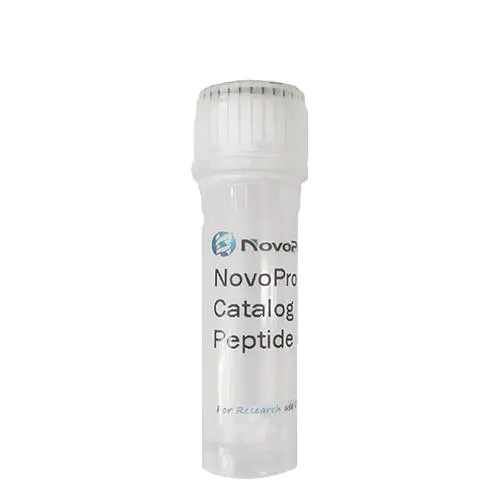
SIFamide peptide
Not For Human Use, Lab Use Only.
Cat.#: 318512
Special Price 222.70 USD
Availability:
5 working days
-
Product Name
SIFamide peptide
-
Documents
Batch to batch variation of the purity
-
Sequence Shortening
TRKLPFNGSIF-NH2
-
Sequence
H-Thr-Arg-Lys-Leu-Pro-Phe-Asn-Gly-Ser-Ile-Phe-NH2
-
Length (aa)
11
-
Peptide Purity (HPLC)
99.46%
-
Molecular Formula
C60H94N16O15
-
Molecular Weight
1278.5
-
Source
Synthetic
-
Form
Powder
-
Description
SIFamide is a conserved neuropeptide first identified in arthropods, with its amino acid sequence maintained across diverse arthropod lineages, highlighting its evolutionary significance. In Drosophila melanogaster, it is produced by just four neurons in the pars intercerebralis (PI) of the brain, which send widespread projections to key brain regions like the antennal lobes (AL), subesophageal ganglia (SOG), and central complex—areas critical for sensory processing and behavior regulation. Functionally, SIFamide acts as a key integrator in the neuropeptide network controlling feeding: it translates hunger signals into enhanced appetitive behaviors (such as odor- and taste-guided foraging) and increased food intake by modulating the activity of olfactory neurons, particularly sensitizing circuits responsive to appetitive odors. It achieves this by integrating both orexigenic (feeding-stimulating, e.g., hugin-PK) and anorexigenic (feeding-suppressing, e.g., MIP) signals, balancing sensory responsiveness with metabolic state. Beyond feeding, SIFamide also influences other behaviors like courtship and sleep in Drosophila, and its receptor shares evolutionary homology with the vertebrate gonadotropin inhibitory hormone receptor (GnIHR), suggesting conserved roles in prioritizing feeding over other physiological processes (e.g., reproduction) across phyla.
-
Storage Guidelines
Normally, this peptide will be delivered in lyophilized form and should be stored in a freezer at or below -20 °C. For more details, please refer to the manual: Handling and Storage of Synthetic Peptides
-
References
- Dircksen H, Neupert S, Predel R, Verleyen P, Huybrechts J, Strauss J, Hauser F, Stafflinger E, Schneider M, Pauwels K, Schoofs L, Grimmelikhuijzen CJ Genomics, transcriptomics, and peptidomics of Daphnia pulex neuropeptides and protein hormones J Proteome Res 2011 Oct 7;10(10):4478-504
- Martelli C, Pech U, Kobbenbring S, Pauls D, Bahl B, Sommer MV, Pooryasin A, Barth J, Arias CWP, Vassiliou C, Luna AJF, Poppinga H, Richter FG, Wegener C, Fiala A, Riemensperger T. SIFamide Translates Hunger Signals into Appetitive and Feeding Behavior in Drosophila. Cell Rep. 2017 Jul 11;20(2):464-478. doi: 10.1016/j.celrep.2017.06.043. PMID: 28700946.
-
About TFA salt
Trifluoroacetic acid (TFA) is a common counterion from the purification process using High-Performance Liquid Chromatography (HPLC). The presence of TFA can affect the peptide's net weight, appearance, and solubility.
Impact on Net Weight: The TFA salt contributes to the total mass of the product. In most cases, the peptide content constitutes >80% of the total weight, with TFA accounting for the remainder.
Solubility: TFA salts generally enhance the solubility of peptides in aqueous solutions.
In Biological Assays: For most standard in vitro assays, the residual TFA levels do not cause interference. However, for highly sensitive cellular or biochemical studies, please be aware of its presence.
-
Molar Concentration Calculator
-
Dilution Calculator
-
Percent Concentration Calculator
Mass (g) = Concentration (mol/L) × Volume (L) × Molecular Weight (g/mol)
Related Products / Services
• Peptide Services: NovoPro's peptide synthesis services include standard chemical peptide synthesis, peptide modification, peptide libraries, and recombinant peptide expression.
• Standard Peptide Synthesis: NovoPro offers quality peptides at the most competitive prices in the industry, starting at $3.20 per amino acid. NovoPro provides PepBox – Automatic Quote Tool for online price calculation.
• Peptide Modifications: NovoPro offers a wide range of peptide modification services including isotope labeling (2H, 15N, and 13C), multiple disulfide bonds, multiple phosphorylations, KLH, BSA, ovalbumin, amidation, acetylation, biotin, FITC, etc.
Please note: All products are "FOR RESEARCH USE ONLY AND ARE NOT INTENDED FOR DIAGNOSTIC OR THERAPEUTIC USE"