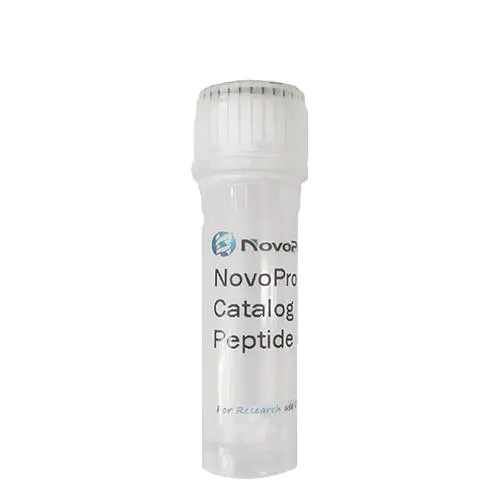
PpNLP peptide
Not For Human Use, Lab Use Only.
Cat.#: 319400
Special Price 169.90 USD
Availability:
5 working days
-
Product Name
PpNLP peptide
-
Documents
Batch to batch variation of the purity
-
Sequence Shortening
H-AIMYSWYFPKDSPVTGLGHR-OH
-
Sequence
H-Ala-Ile-Met-Tyr-Ser-Trp-Tyr-Phe-Pro-Lys-Asp-Ser-Pro-Val-Thr-Gly-Leu-Gly-His-Arg-OH
-
Length (aa)
20
-
Peptide Purity (HPLC)
95.32%
-
Molecular Formula
C109H157N27O28S
-
Molecular Weight
2325.64
-
Source
Synthetic
-
Form
Powder
-
Description
PpNLP is a protein found in Phytophthora parasitica, a type of oomycete microbe. It is a necrosis and ethylene-inducing peptide that acts as a virulence factor, causing damage to host cells. PpNLP carries a conserved peptide pattern called nlp20, which triggers immunity-associated plant defenses and immunity to microbial infection in Arabidopsis thaliana and related plant species. The nlp20 motif is missing in Pectobacterium carotovorum NLP (PccNLP), suggesting that cytotoxic NLPs carrying the nlp20 motif are potentially capable of evoking plant immunity through two different mechanisms: toxin action and a classical PAMP motif. The immunogenic activities of PpNLP and its orthologs have been studied in Arabidopsis, showing the induction of ethylene formation, MAPK activation, production of reactive oxygen species, PR1::GUS expression, and callose apposition. These findings highlight the complex and diverse mechanisms of microbe sensing in plant-microbe interactions.
-
Storage Guidelines
Normally, this peptide will be delivered in lyophilized form and should be stored in a freezer at or below -20 °C. For more details, please refer to the manual: Handling and Storage of Synthetic Peptides
-
References
- Böhm H, Albert I, Oome S, Raaymakers TM, Van den Ackerveken G, Nürnberger T. A conserved peptide pattern from a widespread microbial virulence factor triggers pattern-induced immunity in Arabidopsis. PLoS Pathog. 2014 Nov 6;10(11):e1004491. doi: 10.1371/journal.ppat.1004491. PMID: 25375108; PMCID: PMC4223075.
-
About TFA salt
Trifluoroacetic acid (TFA) is a common counterion from the purification process using High-Performance Liquid Chromatography (HPLC). The presence of TFA can affect the peptide's net weight, appearance, and solubility.
Impact on Net Weight: The TFA salt contributes to the total mass of the product. In most cases, the peptide content constitutes >80% of the total weight, with TFA accounting for the remainder.
Solubility: TFA salts generally enhance the solubility of peptides in aqueous solutions.
In Biological Assays: For most standard in vitro assays, the residual TFA levels do not cause interference. However, for highly sensitive cellular or biochemical studies, please be aware of its presence.
-
Molar Concentration Calculator
-
Dilution Calculator
-
Percent Concentration Calculator
Mass (g) = Concentration (mol/L) × Volume (L) × Molecular Weight (g/mol)
Related Products / Services
• Peptide Services: NovoPro's peptide synthesis services include standard chemical peptide synthesis, peptide modification, peptide libraries, and recombinant peptide expression.
• Standard Peptide Synthesis: NovoPro offers quality peptides at the most competitive prices in the industry, starting at $3.20 per amino acid. NovoPro provides PepBox – Automatic Quote Tool for online price calculation.
• Peptide Modifications: NovoPro offers a wide range of peptide modification services including isotope labeling (2H, 15N, and 13C), multiple disulfide bonds, multiple phosphorylations, KLH, BSA, ovalbumin, amidation, acetylation, biotin, FITC, etc.
Please note: All products are "FOR RESEARCH USE ONLY AND ARE NOT INTENDED FOR DIAGNOSTIC OR THERAPEUTIC USE"