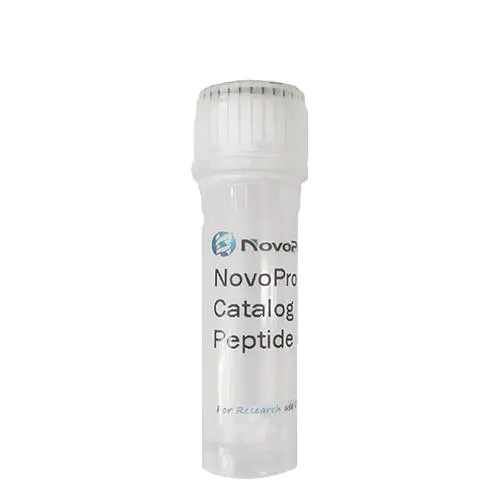
Pigment dispersing factor peptide
Not For Human Use, Lab Use Only.
Cat.#: 316387
Special Price 176.00 USD
Availability:
5 working days
-
Product Name
Pigment dispersing factor peptide
-
Documents
Batch to batch variation of the purity
-
Sequence Shortening
NSELINSLLGLPKNMNNA
-
Sequence
H-Asn-Ser-Glu-Leu-Ile-Asn-Ser-Leu-Leu-Gly-Leu-Pro-Lys-Asn-Met-Asn-Asn-Ala-NH2
-
Length (aa)
18
-
Peptide Purity (HPLC)
95.6%
-
Molecular Formula
C82H141N25O27S
-
Molecular Weight
1941
-
Source
Synthetic
-
Form
Powder
-
Description
Pigment dispersing factor (PDF) is a neuropeptide that plays a crucial role in the circadian clock network of insects, including the honey bee Apis mellifera. PDF is co-localized with the clock protein Period (PER) in a cluster of lateral neurons (LN2) in the brain. The extensive arborizations of these PER/PDF neurons project widely throughout the brain, coming into close proximity with other PER-positive cells, including neurons and glial cells. These projections reach various brain regions such as the optic lobes, protocerebrum, and antennal lobes, positioning PDF neurons to communicate circadian information to multiple neural centers. PDF immunostaining intensity exhibits diurnal and circadian oscillations, with levels peaking during the night and reaching a trough in the early day. This rhythmic variation suggests a time-dependent release of the peptide. PDF neurons, through their widespread fibers, are anatomically suited to convey time-of-day signals to brain areas involved in diverse functions like locomotion and sensory processing. The neuropeptide thus acts as a key neuromodulator within the circadian system, transmitting timing information from central pacemaker cells to downstream neuronal networks.
-
Storage Guidelines
Normally, this peptide will be delivered in lyophilized form and should be stored in a freezer at or below -20 °C. For more details, please refer to the manual: Handling and Storage of Synthetic Peptides
-
References
- Boerjan B, Cardoen D, Bogaerts A, Landuyt B, Schoofs L, Verleyen P Mass spectrometric profiling of (neuro)-peptides in the worker honeybee, Apis mellifera Neuropharmacology 2010 Jan;58(1):248-58
- Beer K, Kolbe E, Kahana NB, Yayon N, Weiss R, Menegazzi P, Bloch G, Helfrich-Förster C. Pigment-Dispersing Factor-expressing neurons convey circadian information in the honey bee brain. Open Biol. 2018 Jan;8(1):170224. doi: 10.1098/rsob.170224. PMID: 29321240; PMCID: PMC5795053.
-
About TFA salt
Trifluoroacetic acid (TFA) is a common counterion from the purification process using High-Performance Liquid Chromatography (HPLC). The presence of TFA can affect the peptide's net weight, appearance, and solubility.
Impact on Net Weight: The TFA salt contributes to the total mass of the product. In most cases, the peptide content constitutes >80% of the total weight, with TFA accounting for the remainder.
Solubility: TFA salts generally enhance the solubility of peptides in aqueous solutions.
In Biological Assays: For most standard in vitro assays, the residual TFA levels do not cause interference. However, for highly sensitive cellular or biochemical studies, please be aware of its presence.
-
Molar Concentration Calculator
-
Dilution Calculator
-
Percent Concentration Calculator
Mass (g) = Concentration (mol/L) × Volume (L) × Molecular Weight (g/mol)
Related Products / Services
• Peptide Services: NovoPro's peptide synthesis services include standard chemical peptide synthesis, peptide modification, peptide libraries, and recombinant peptide expression.
• Standard Peptide Synthesis: NovoPro offers quality peptides at the most competitive prices in the industry, starting at $3.20 per amino acid. NovoPro provides PepBox – Automatic Quote Tool for online price calculation.
• Peptide Modifications: NovoPro offers a wide range of peptide modification services including isotope labeling (2H, 15N, and 13C), multiple disulfide bonds, multiple phosphorylations, KLH, BSA, ovalbumin, amidation, acetylation, biotin, FITC, etc.
Please note: All products are "FOR RESEARCH USE ONLY AND ARE NOT INTENDED FOR DIAGNOSTIC OR THERAPEUTIC USE"