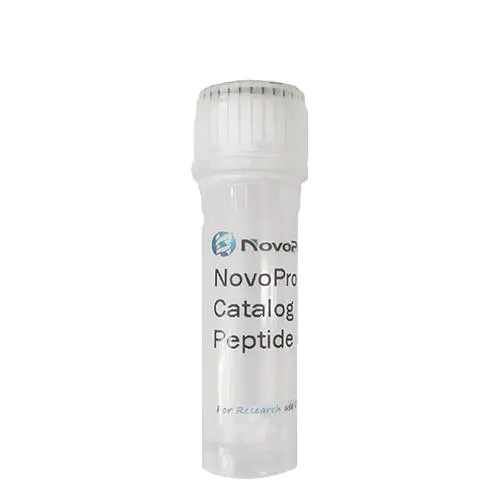
PACAP-38 (6-38) peptide
Not For Human Use, Lab Use Only.
Cat.#: 307800
Special Price 322.70 USD
Availability:
4 weeks
-
Product Name
PACAP-38 (6-38) peptide
-
Documents
Batch to batch variation of the purity
-
Sequence Shortening
H-FTDSYSRYRKQMAVKKYLAAVLGKRYKQRVKNK-NH2
-
Sequence
H-Phe-Thr-Asp-Ser-Tyr-Ser-Arg-Tyr-Arg-Lys-Gln-Met-Ala-Val-Lys-Lys-Tyr-Leu-Ala-Ala-Val-Leu-Gly-Lys-Arg-Tyr-Lys-Gln-Arg-Val-Lys-Asn-Lys-NH2
-
Length (aa)
33
-
Peptide Purity (HPLC)
95.6%
-
Molecular Formula
C182H300N56O45S
-
Molecular Weight
4024.72
-
CAS No.
143748-18-9
-
PubChem CID
131954572
-
Source
Synthetic
-
Form
Powder
-
Description
PACAP-38 (6-38) is a truncated form of pituitary adenylate cyclase-activating polypeptide (PACAP), specifically lacking the first five N-terminal amino acids. This peptide functions as a selective antagonist for the PAC1 receptor, one of the primary receptors for PACAP. PACAP and its receptors, including PAC1, are widely expressed in the nervous system and peripheral tissues, where they regulate diverse physiological processes such as neurotransmission and smooth muscle activity.
In studies involving NGF-overexpressing (NGF-OE) mice, intravesical administration of PACAP-38 (6-38) at 300 nM significantly modulated bladder function by increasing intercontraction intervals and void volumes while reducing baseline bladder pressure and non-voiding contractions. The peptide also decreased referred pelvic sensitivity in these mice, highlighting its role in PACAP/PAC1 signaling pathways associated with visceral sensation and smooth muscle regulation. No effects were observed in wild-type mice, indicating specificity in pathological conditions involving NGF overexpression.
-
Storage Guidelines
Normally, this peptide will be delivered in lyophilized form and should be stored in a freezer at or below -20 °C. For more details, please refer to the manual: Handling and Storage of Synthetic Peptides
-
References
- P.Robberecht et al., Eur. J. Biochem., 207, 239 (1992)
- P.Robberecht et al., Mol. Pharmacol., 42, 347 (1992)
- F.Ohno et al., Regul. Peptides, 126, 115 (2005)
- Girard BM, Malley SE, Mathews MM, May V, Vizzard MA. Intravesical PAC1 Receptor Antagonist, PACAP(6-38), Reduces Urinary Bladder Frequency and Pelvic Sensitivity in NGF-OE Mice. J Mol Neurosci. 2016 Jun;59(2):290-9. doi: 10.1007/s12031-016-0764-1. Epub 2016 May 4. PMID: 27146136; PMCID: PMC5252828.
-
About TFA salt
Trifluoroacetic acid (TFA) is a common counterion from the purification process using High-Performance Liquid Chromatography (HPLC). The presence of TFA can affect the peptide's net weight, appearance, and solubility.
Impact on Net Weight: The TFA salt contributes to the total mass of the product. In most cases, the peptide content constitutes >80% of the total weight, with TFA accounting for the remainder.
Solubility: TFA salts generally enhance the solubility of peptides in aqueous solutions.
In Biological Assays: For most standard in vitro assays, the residual TFA levels do not cause interference. However, for highly sensitive cellular or biochemical studies, please be aware of its presence.
-
Molar Concentration Calculator
-
Dilution Calculator
-
Percent Concentration Calculator
Mass (g) = Concentration (mol/L) × Volume (L) × Molecular Weight (g/mol)
Related Products / Services
• Peptide Services: NovoPro's peptide synthesis services include standard chemical peptide synthesis, peptide modification, peptide libraries, and recombinant peptide expression.
• Standard Peptide Synthesis: NovoPro offers quality peptides at the most competitive prices in the industry, starting at $3.20 per amino acid. NovoPro provides PepBox – Automatic Quote Tool for online price calculation.
• Peptide Modifications: NovoPro offers a wide range of peptide modification services including isotope labeling (2H, 15N, and 13C), multiple disulfide bonds, multiple phosphorylations, KLH, BSA, ovalbumin, amidation, acetylation, biotin, FITC, etc.
Please note: All products are "FOR RESEARCH USE ONLY AND ARE NOT INTENDED FOR DIAGNOSTIC OR THERAPEUTIC USE"