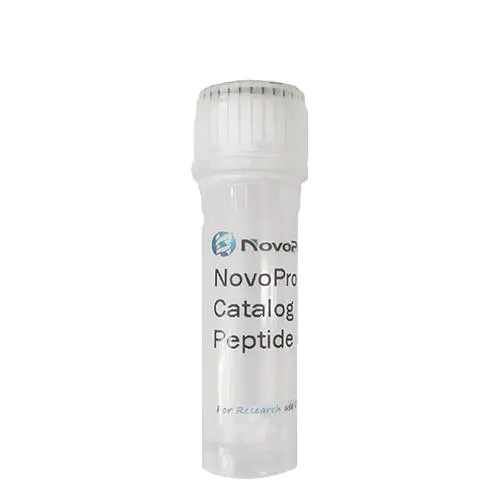
KKFFVLK peptide
Not For Human Use, Lab Use Only.
Cat.#: 319746
Special Price 162.70 USD
Availability:
1-2 weeks
-
Product Name
KKFFVLK peptide
-
Documents
Batch to batch variation of the purity
-
Sequence Shortening
H-KKFFVLK-OH
-
Sequence
H-Lys-Lys-Phe-Phe-Val-Leu-Lys-OH
-
Length (aa)
7
-
Peptide Purity (HPLC)
95.96%
-
Molecular Formula
C47H76N10O8
-
Molecular Weight
909.17
-
Source
Synthetic
-
Form
Powder
-
Description
KKFFVLK polypeptide is a peptide amphiphile (PA). This polypeptide contains a hexadecyl lipid chain and a peptide sequence with two phenylalanine (FF) residues at the C-terminus. The FF residues drive self-assembly through hydrophobic and π-stacking interactions. It is designed based on the KLVFF core motif from the amyloid beta (Aβ) peptide. The serine protease α-chymotrypsin can cleave KKFFVLK at two sites, leading to products KKF with FVLK and KKFF with VLK. KKFFVLK forms nanotubes and helical ribbons at room temperature, which is associated with its substantial β-sheet secondary structure. This nanostructure causes light scattering and a partly cloudy appearance in solution. The ability of KKFFVLK to form specific nanostructures and its responsiveness to enzymatic cleavage make it an interesting candidate for applications such as enzyme-responsive delivery systems or in the study of self-assembly processes related to biomaterials and nanotechnology.
-
Storage Guidelines
Normally, this peptide will be delivered in lyophilized form and should be stored in a freezer at or below -20 °C. For more details, please refer to the manual: Handling and Storage of Synthetic Peptides
-
References
- Dehsorkhi A, Hamley IW, Seitsonen J, Ruokolainen J. Tuning self-assembled nanostructures through enzymatic degradation of a peptide amphiphile. Langmuir. 2013 Jun 4;29(22):6665-72. doi: 10.1021/la401025r. Epub 2013 May 17. PMID: 23651310; PMCID: PMC3678293.
-
About TFA salt
Trifluoroacetic acid (TFA) is a common counterion from the purification process using High-Performance Liquid Chromatography (HPLC). The presence of TFA can affect the peptide's net weight, appearance, and solubility.
Impact on Net Weight: The TFA salt contributes to the total mass of the product. In most cases, the peptide content constitutes >80% of the total weight, with TFA accounting for the remainder.
Solubility: TFA salts generally enhance the solubility of peptides in aqueous solutions.
In Biological Assays: For most standard in vitro assays, the residual TFA levels do not cause interference. However, for highly sensitive cellular or biochemical studies, please be aware of its presence.
-
Molar Concentration Calculator
-
Dilution Calculator
-
Percent Concentration Calculator
Mass (g) = Concentration (mol/L) × Volume (L) × Molecular Weight (g/mol)
Related Products / Services
• Peptide Services: NovoPro's peptide synthesis services include standard chemical peptide synthesis, peptide modification, peptide libraries, and recombinant peptide expression.
• Standard Peptide Synthesis: NovoPro offers quality peptides at the most competitive prices in the industry, starting at $3.20 per amino acid. NovoPro provides PepBox – Automatic Quote Tool for online price calculation.
• Peptide Modifications: NovoPro offers a wide range of peptide modification services including isotope labeling (2H, 15N, and 13C), multiple disulfide bonds, multiple phosphorylations, KLH, BSA, ovalbumin, amidation, acetylation, biotin, FITC, etc.
Please note: All products are "FOR RESEARCH USE ONLY AND ARE NOT INTENDED FOR DIAGNOSTIC OR THERAPEUTIC USE"