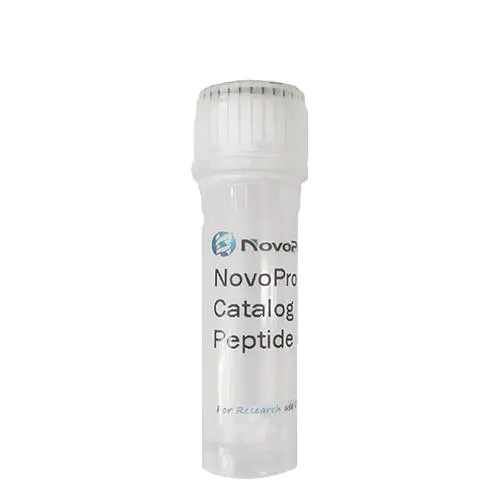
GLP-1 (7-37) peptide
Not For Human Use, Lab Use Only.
Cat.#: 319000
Special Price 377.60 USD
Availability:
4 weeks
-
Product Name
GLP-1 (7-37) peptide
-
Documents
Batch to batch variation of the purity
-
Sequence Shortening
H-HAEGTFTSDVSSYLEGQAAKEFIAWLVKGRG-OH
-
Sequence
H-His-Ala-Glu-Gly-Thr-Phe-Thr-Ser-Asp-Val-Ser-Ser-Tyr-Leu-Glu-Gly-Gln-Ala-Ala-Lys-Glu-Phe-Ile-Ala-Trp-Leu-Val-Lys-Gly-Arg-Gly-OH
-
Length (aa)
31
-
Peptide Purity (HPLC)
95.73%
-
Molecular Formula
C151H228N40O47
-
Molecular Weight
3355.65
-
Source
Synthetic
-
Form
Powder
-
Description
GLP-1 (7-37) is an endogenous truncated form of GLP-1 that arises from proglucagon processing in intestinal endocrine L cells, GLP-1 (7-37) acts as a GLP-1 receptor agonist and is an insulinotropic hormone that augments glucose induced insulin secretion. GLP-1 (7-37) and derivatives GLP-1 (9-37) and GLP-1 (28-37) can reduce plaque inflammation and increase phenotypic characteristics of plaque stability in a murine model of atherosclerosis.
-
Storage Guidelines
Normally, this peptide will be delivered in lyophilized form and should be stored in a freezer at or below -20 °C. For more details, please refer to the manual: Handling and Storage of Synthetic Peptides
-
References
- Hargrove et al (1995) Glucose-dependent action of glucagon-like peptide-1 (7-37) in vivo during short- or long-term administration. Metabolism 44(9) 1231 PMID: 7666800
- Vahl (2003) Effects of GLP-1-(7-36)NH2, GLP-1-(7-37), and GLP-1- (9-36)NH2 on intravenous glucose tolerance and glucose-induced insulin secretion in healthy humans. J Clin Endocrinol Metab. 88(4) 1772 PMID: 12679472
- Burgmaier et al (2013) Glucagon-like peptide-1 (GLP-1) and its split products GLP-1(9-37) and GLP-1(28-37) stabilize atherosclerotic lesions in apoe⁻/⁻ mice. Atherosclerosis 231(2) 427 PMID: 24267262
-
About TFA salt
Trifluoroacetic acid (TFA) is a common counterion from the purification process using High-Performance Liquid Chromatography (HPLC). The presence of TFA can affect the peptide's net weight, appearance, and solubility.
Impact on Net Weight: The TFA salt contributes to the total mass of the product. In most cases, the peptide content constitutes >80% of the total weight, with TFA accounting for the remainder.
Solubility: TFA salts generally enhance the solubility of peptides in aqueous solutions.
In Biological Assays: For most standard in vitro assays, the residual TFA levels do not cause interference. However, for highly sensitive cellular or biochemical studies, please be aware of its presence.
-
Molar Concentration Calculator
-
Dilution Calculator
-
Percent Concentration Calculator
Mass (g) = Concentration (mol/L) × Volume (L) × Molecular Weight (g/mol)
Related Products / Services
• Peptide Services: NovoPro's peptide synthesis services include standard chemical peptide synthesis, peptide modification, peptide libraries, and recombinant peptide expression.
• Standard Peptide Synthesis: NovoPro offers quality peptides at the most competitive prices in the industry, starting at $3.20 per amino acid. NovoPro provides PepBox – Automatic Quote Tool for online price calculation.
• Peptide Modifications: NovoPro offers a wide range of peptide modification services including isotope labeling (2H, 15N, and 13C), multiple disulfide bonds, multiple phosphorylations, KLH, BSA, ovalbumin, amidation, acetylation, biotin, FITC, etc.
Please note: All products are "FOR RESEARCH USE ONLY AND ARE NOT INTENDED FOR DIAGNOSTIC OR THERAPEUTIC USE"