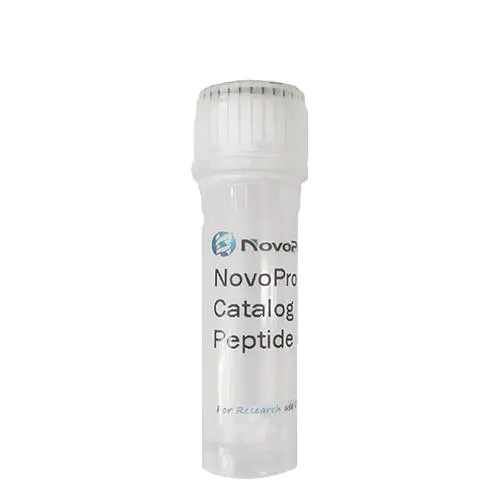
Epobis peptide
Not For Human Use, Lab Use Only.
Cat.#: 319807
Special Price 165.10 USD
Availability:
1-2 weeks
-
Product Name
Epobis peptide
-
Documents
Batch to batch variation of the purity
-
Sequence Shortening
H-NENITVPDTKVNFYAWKR-OH
-
Sequence
H-Asn-Glu-Asn-Ile-Thr-Val-Pro-Asp-Thr-Lys-Val-Asn-Phe-Tyr-Ala-Trp-Lys-Arg-OH
-
Length (aa)
18
-
Peptide Purity (HPLC)
95.52%
-
Molecular Formula
C100H151N27O29
-
Molecular Weight
2195.42
-
CAS No.
915091-83-7
-
PubChem CID
171361015
-
Source
Synthetic
-
Form
Powder
-
Description
Epobis is a synthetic, dendrimeric peptide derived from the sequence of human erythropoietin (EPO), specifically corresponding to amino acids 63-80 of the EPO protein. This peptide binds to the EPO receptor with an apparent KD of approximately 60 nM, activating downstream signaling pathways, including STAT5 transcription factor activation. Epobis demonstrates neuroprotective properties by promoting neuritogenesis and enhancing neuronal survival in vitro across various neuronal cell types, including cerebellar granule neurons, hippocampal neurons, and primary motoneurons.
In addition to its neuroprotective effects, Epobis exhibits anti-inflammatory activity by reducing tumor necrosis factor (TNF) secretion from activated macrophages and microglia. The peptide is capable of crossing the blood-brain barrier, as evidenced by its detection in cerebrospinal fluid following systemic administration. Notably, Epobis retains the neuroprotective and anti-inflammatory properties of EPO but lacks erythropoietic activity, making it a promising candidate for studying EPO receptor-mediated signaling in neural systems.
-
Storage Guidelines
Normally, this peptide will be delivered in lyophilized form and should be stored in a freezer at or below -20 °C. For more details, please refer to the manual: Handling and Storage of Synthetic Peptides
-
References
- Dmytriyeva O, Pankratova S, Korshunova I, Walmod PS. Epobis is a Nonerythropoietic and Neuroprotective Agonist of the Erythropoietin Receptor with Anti-Inflammatory and Memory Enhancing Effects. Mediators Inflamm. 2016;2016:1346390. doi: 10.1155/2016/1346390. Epub 2016 Nov 21. PMID: 27990061; PMCID: PMC5136666.
-
About TFA salt
Trifluoroacetic acid (TFA) is a common counterion from the purification process using High-Performance Liquid Chromatography (HPLC). The presence of TFA can affect the peptide's net weight, appearance, and solubility.
Impact on Net Weight: The TFA salt contributes to the total mass of the product. In most cases, the peptide content constitutes >80% of the total weight, with TFA accounting for the remainder.
Solubility: TFA salts generally enhance the solubility of peptides in aqueous solutions.
In Biological Assays: For most standard in vitro assays, the residual TFA levels do not cause interference. However, for highly sensitive cellular or biochemical studies, please be aware of its presence.
-
Molar Concentration Calculator
-
Dilution Calculator
-
Percent Concentration Calculator
Mass (g) = Concentration (mol/L) × Volume (L) × Molecular Weight (g/mol)
Related Products / Services
• Peptide Services: NovoPro's peptide synthesis services include standard chemical peptide synthesis, peptide modification, peptide libraries, and recombinant peptide expression.
• Standard Peptide Synthesis: NovoPro offers quality peptides at the most competitive prices in the industry, starting at $3.20 per amino acid. NovoPro provides PepBox – Automatic Quote Tool for online price calculation.
• Peptide Modifications: NovoPro offers a wide range of peptide modification services including isotope labeling (2H, 15N, and 13C), multiple disulfide bonds, multiple phosphorylations, KLH, BSA, ovalbumin, amidation, acetylation, biotin, FITC, etc.
Please note: All products are "FOR RESEARCH USE ONLY AND ARE NOT INTENDED FOR DIAGNOSTIC OR THERAPEUTIC USE"