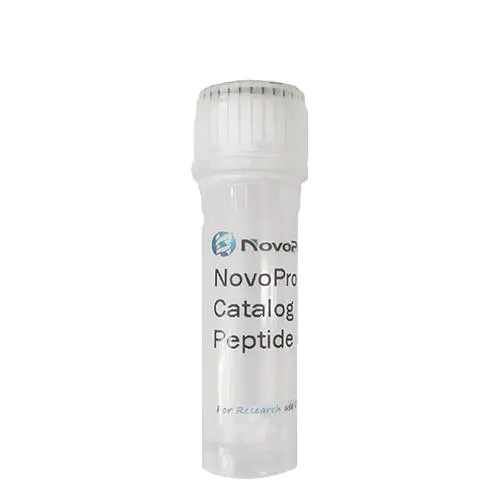
Apelin-36 (human) peptide
Not For Human Use, Lab Use Only.
Cat.#: 315662
Special Price 546.50 USD
Availability:
4 weeks
-
Product Name
Apelin-36 (human) peptide
-
Documents
Batch to batch variation of the purity
-
Sequence Shortening
LVQPRGSRNGPGPWQGGRRKFRRQRPRLSHKGPMPF
-
Sequence
H-Leu-Val-Gln-Pro-Arg-Gly-Ser-Arg-Asn-Gly-Pro-Gly-Pro-Trp-Gln-Gly-Gly-Arg-Arg-Lys-Phe-Arg-Arg-Gln-Arg-Pro-Arg-Leu-Ser-His-Lys-Gly-Pro-Met-Pro-Phe-OH
-
Length (aa)
36
-
Peptide Purity (HPLC)
98.1%
-
Molecular Formula
C184H297N69O43S
-
Molecular Weight
4195.89
-
CAS No.
252642-12-9
-
Source
Synthetic
-
Form
Powder
-
Description
The orphan G protein-coupled receptor APJ has been shown to be a coreceptor for human and simian immunodeficiency virus (HIV and SIV) strains. As long as apelin is an endogenous ligand for the APJ receptor, inhibitory effects of apelin peptides on HIV infection have been examined and it has been found that the apelin peptides inhibit the entry of some HIV-1 and HIV-2 strains into NP-2/CD4 cells expressing APJ. For apelin-36 the strongest inhibitory efficiency has been reported.
-
Storage Guidelines
Normally, this peptide will be delivered in lyophilized form and should be stored in a freezer at or below -20 °C. For more details, please refer to the manual: Handling and Storage of Synthetic Peptides
-
References
- Palmer ES, Irwin N, O'Harte FP. Potential Therapeutic Role for Apelin and Related Peptides in Diabetes: An Update. Clin Med Insights Endocrinol Diabetes. 2022 Feb 11;15:11795514221074679. doi: 10.1177/11795514221074679. PMID: 35177945; PMCID: PMC8844737.
- K.Tatemoto et al., Biochem. Biophys. Res. Commun., 251, 471 (1998)
- M.Hosoya et al., J. Biol. Chem., 275, 21061 (2000)
- M.X.Zou et al., FEBS Lett., 473, 15 (2000)
- M.J.Kleinz and A.P.Davenport (2005)
- , Regul. Pept., 118, 119 (2004)
-
About TFA salt
Trifluoroacetic acid (TFA) is a common counterion from the purification process using High-Performance Liquid Chromatography (HPLC). The presence of TFA can affect the peptide's net weight, appearance, and solubility.
Impact on Net Weight: The TFA salt contributes to the total mass of the product. In most cases, the peptide content constitutes >80% of the total weight, with TFA accounting for the remainder.
Solubility: TFA salts generally enhance the solubility of peptides in aqueous solutions.
In Biological Assays: For most standard in vitro assays, the residual TFA levels do not cause interference. However, for highly sensitive cellular or biochemical studies, please be aware of its presence.
-
Molar Concentration Calculator
-
Dilution Calculator
-
Percent Concentration Calculator
Mass (g) = Concentration (mol/L) × Volume (L) × Molecular Weight (g/mol)
Peptide Property
- Analysed Sequence:H-LVQPRGSRNGPGPWQGGRRKFRRQRPRLSHKGPMPF-OH
- Chemical Formula:C184H297N69O43S
- Sequence length:36
- Extinction coefficient:5690 M-1cm-1
- GRAVY:-1.56
- Mw average:4195.81
- Theoretical pI:13.25
- Data Source:Peptide Property Calculator
GRAVY = grand average of hydropathy
X: Hydrophobic uncharged residues, like F I L M V W A and P
X: Basic residues, like R K H
X: Acidic residues, like D E
X: Polar uncharged residues, like G S T C N Q and Y
Related Products / Services
• Peptide Services: NovoPro's peptide synthesis services include standard chemical peptide synthesis, peptide modification, peptide libraries, and recombinant peptide expression.
• Standard Peptide Synthesis: NovoPro offers quality peptides at the most competitive prices in the industry, starting at $3.20 per amino acid. NovoPro provides PepBox – Automatic Quote Tool for online price calculation.
• Peptide Modifications: NovoPro offers a wide range of peptide modification services including isotope labeling (2H, 15N, and 13C), multiple disulfide bonds, multiple phosphorylations, KLH, BSA, ovalbumin, amidation, acetylation, biotin, FITC, etc.
Please note: All products are "FOR RESEARCH USE ONLY AND ARE NOT INTENDED FOR DIAGNOSTIC OR THERAPEUTIC USE"