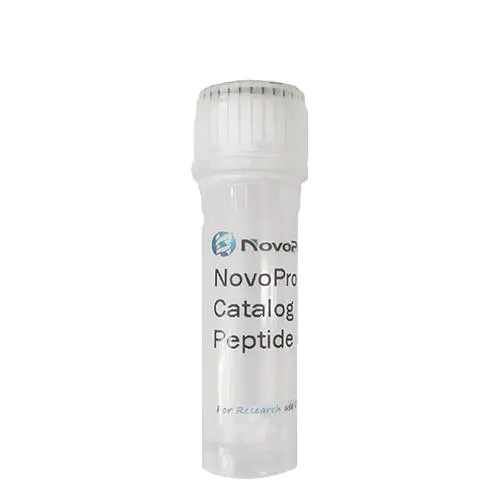
β-Amyloid (1-42), Human peptide
Not For Human Use, Lab Use Only.
Cat.#: 318878
Special Price 395.00 USD
Availability:
5 working days
-
Product Name
β-Amyloid (1-42), Human peptide
-
Documents
Batch to batch variation of the purity
-
Sequence Shortening
H-DAEFRHDSGYEVHHQKLVFFAEDVGSNKGAIIGLMVGGVVIA-OH
-
Sequence
H-Asp-Ala-Glu-Phe-Arg-His-Asp-Ser-Gly-Tyr-Glu-Val-His-His-Gln-Lys-Leu-Val-Phe-Phe-Ala-Glu-Asp-Val-Gly-Ser-Asn-Lys-Gly-Ala-Ile-Ile-Gly-Leu-Met-Val-Gly-Gly-Val-Val-Ile-Ala-OH
-
Length (aa)
42
-
Peptide Purity (HPLC)
95.41%
-
Molecular Formula
C203H311N55O60S
-
Molecular Weight
4514.1
-
Source
Synthetic
-
Form
Powder
-
Description
It is found that Aβ1-42 altered the expression of several key glycosyltransferases and glycosidases, including fucosyltransferase IX (FUT9), sialyltransferase III (ST-III), glucosylceramide ceramidase (GLCC), and mitochondrial sialidase (Neu4). FUT9 is a key enzyme for the synthesis of the Lewis X carbohydrate epitope, which is known to be expressed in stem cells. Aβ1-42 also stimulated the Notch1 intracellular domain (NICD) by upregulation of the expression of Musashi-1 and the paired box protein, Pax6. Thus, Aβ1-42 upregulates NSC proliferation by modulating the expression of several glycogenes involved in Notch signaling.
β-Amyloid (1-42) is soluble in hexafluoroisopropanol (HFIP), DMSO, 0.1% aqueous ammonia, 50 mM TRlS · HCl, or 1 mM NaOH. Reconstitution inHFlP or DMSO takes time whereas ammonia rapidly dissolves thepeptide.
The β-Amyloid series peptides can be treated with 1,1,1,3,3,3-hexafluoro-2-propanol (HFlP) to guarantee a monomeric state, lyophilized, and stored at-20 °C until use.
-
Storage Guidelines
Normally, this peptide will be delivered in lyophilized form and should be stored in a freezer at or below -20 °C. For more details, please refer to the manual: Handling and Storage of Synthetic Peptides
-
References
- Itokazu Y, Yu RK. Amyloid β-peptide 1-42 modulates the proliferation of mouse neural stem cells: upregulation of fucosyltransferase IX and notch signaling. Mol Neurobiol. 2014 Aug;50(1):186-96. doi: 10.1007/s12035-014-8634-8. Epub 2014 Jan 17. PMID: 24436056; PMCID: PMC4102671.
-
About TFA salt
Trifluoroacetic acid (TFA) is a common counterion from the purification process using High-Performance Liquid Chromatography (HPLC). The presence of TFA can affect the peptide's net weight, appearance, and solubility.
Impact on Net Weight: The TFA salt contributes to the total mass of the product. In most cases, the peptide content constitutes >80% of the total weight, with TFA accounting for the remainder.
Solubility: TFA salts generally enhance the solubility of peptides in aqueous solutions.
In Biological Assays: For most standard in vitro assays, the residual TFA levels do not cause interference. However, for highly sensitive cellular or biochemical studies, please be aware of its presence.
-
Molar Concentration Calculator
-
Dilution Calculator
-
Percent Concentration Calculator
Mass (g) = Concentration (mol/L) × Volume (L) × Molecular Weight (g/mol)
Related Products / Services
• Peptide Services: NovoPro's peptide synthesis services include standard chemical peptide synthesis, peptide modification, peptide libraries, and recombinant peptide expression.
• Standard Peptide Synthesis: NovoPro offers quality peptides at the most competitive prices in the industry, starting at $3.20 per amino acid. NovoPro provides PepBox – Automatic Quote Tool for online price calculation.
• Peptide Modifications: NovoPro offers a wide range of peptide modification services including isotope labeling (2H, 15N, and 13C), multiple disulfide bonds, multiple phosphorylations, KLH, BSA, ovalbumin, amidation, acetylation, biotin, FITC, etc.
Please note: All products are "FOR RESEARCH USE ONLY AND ARE NOT INTENDED FOR DIAGNOSTIC OR THERAPEUTIC USE"